What Makes Something the Same Thing? Identity in the Age of Continuous Deployment
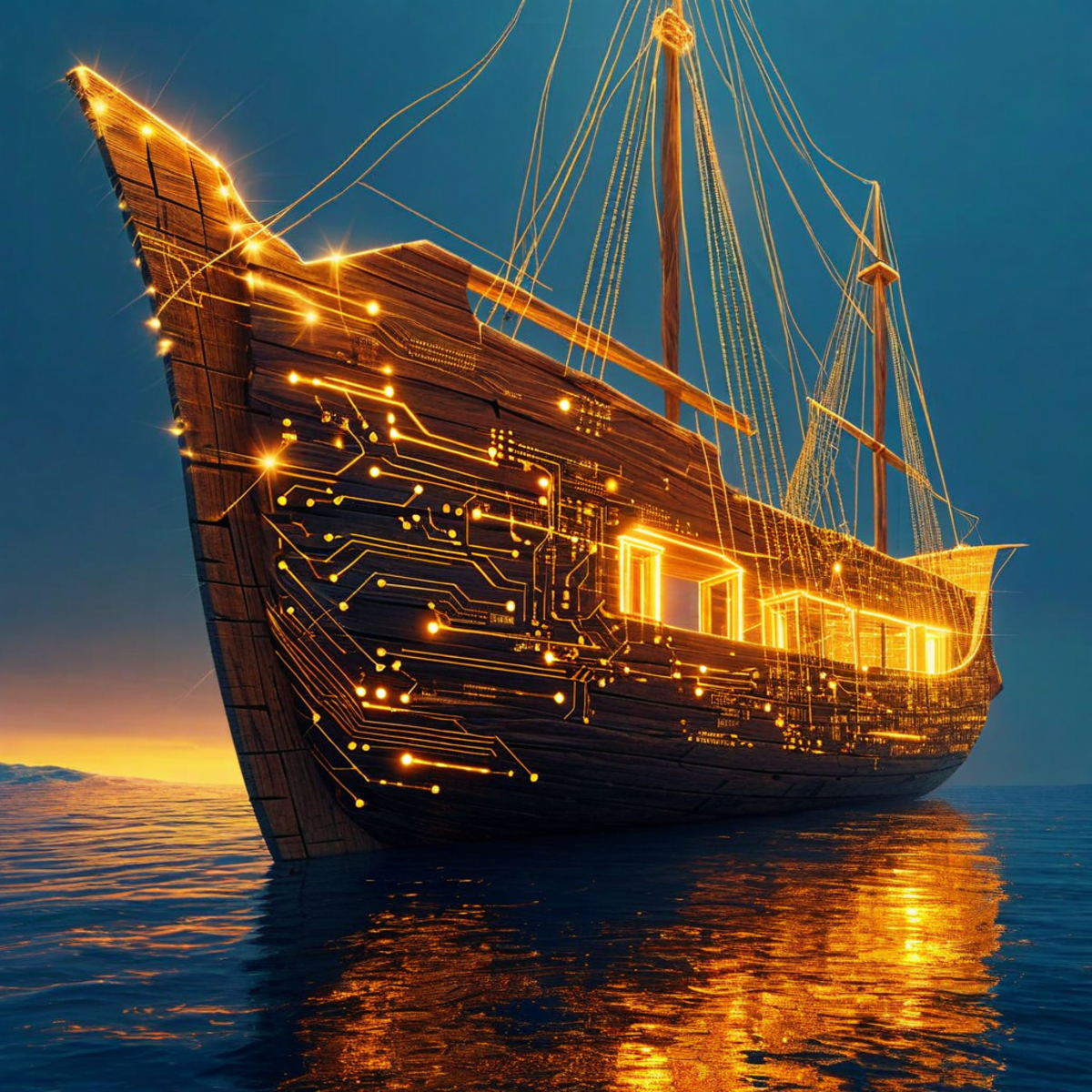
This series began with a simple question: if you replace every plank of a ship, is it still the same ship? Over six posts, we watched that question collide with software rewrites, open source forks, microservices architectures, legacy mainframes, and the permanence of digital identity.
The ancient Greeks never resolved the paradox. Neither have we. But technology has given us something the Greeks didn't have: thousands of real-world experiments running simultaneously, each testing a different theory of identity. The results are messy, contradictory, and surprisingly useful.
What We Found
Each case study in this series located identity in a different place.
The big rewrite showed that identity can survive total code replacement, as long as the transformation is continuous. Twitter replaced every line of Ruby with Scala and Java, plank by plank, and nobody questioned whether it was still Twitter. Netscape replaced everything at once, went silent for three years, and lost the thread. The difference wasn't what changed. It was whether the ship kept sailing during the renovation.[1]
Open source forks revealed that identity fractures when stakeholders disagree about what matters. When Redis changed its license, the code forked into Valkey. Same wood, different flags. The community split along the lines of what they valued most: the code, the name, or the license. Neither fork was wrong. They just answered the identity question differently.[2]
Microservices showed what happens when you design for impermanence from the start. Kubernetes pods live for minutes. Containers are cattle, not pets. The system's identity lives entirely in contracts and specifications, never in any individual component. Modern architecture has made the Ship of Theseus a feature, not a bug.[3]
Legacy systems presented the inverse problem. COBOL mainframes at the Social Security Administration have preserved every original plank for decades. The code hasn't changed. But the people who understand it are retiring, and the institutional knowledge that gives the code meaning is evaporating. The ship is perfectly intact and increasingly unsailable.[4]
Digital identity showed us a paradox the Greeks couldn't have imagined: a ship where the old planks never decay. Every version of your online self persists simultaneously. Your GitHub from 2015 sits next to your GitHub from today. The question isn't whether you're the same person after replacing every cell. It's which version of you people encounter first.[5]
Four Theories, Tested
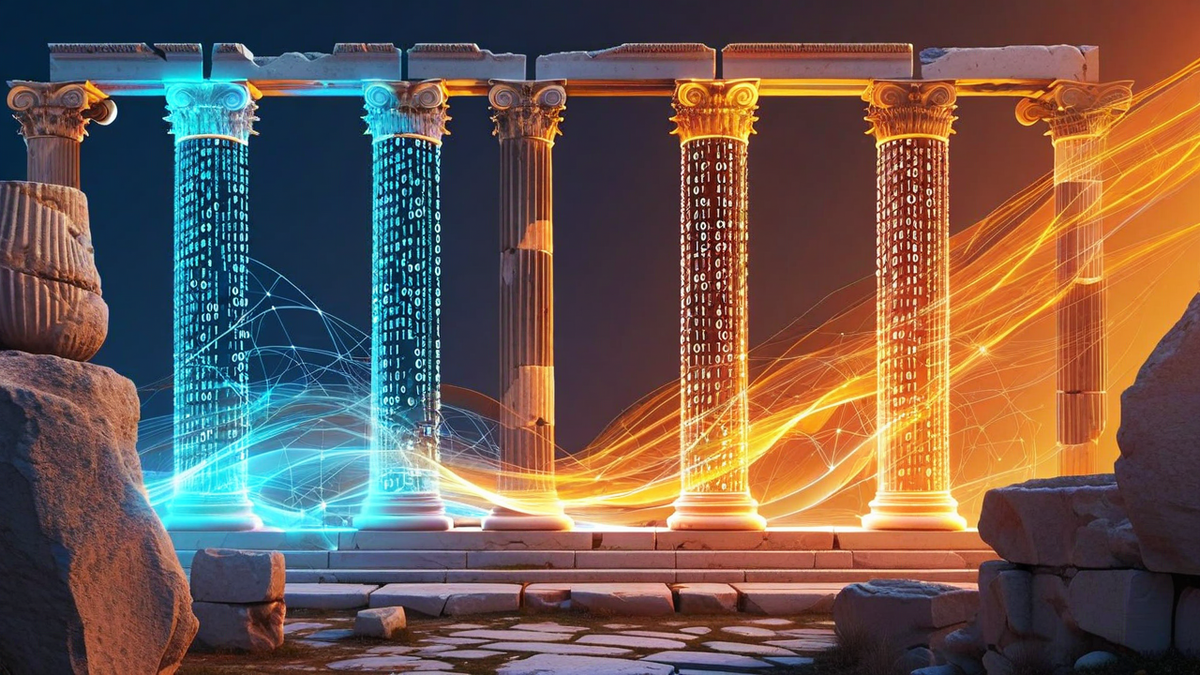
The primer introduced four philosophical frameworks for thinking about identity over time. The series tested each one against real technology.
Material identity says the thing is its stuff. Replace the stuff, lose the identity. This theory works poorly for software. Code can be copied perfectly. A fork contains identical material to the original. Two systems can be materially identical and still be considered different projects. Material identity explains physical objects reasonably well, but software is information, and information doesn't behave like wood.
Spatiotemporal continuity says identity follows the unbroken path through time. The ship that stayed in the harbor, continuously repaired, is the real one. This theory performed better. It explains why incremental rewrites feel like they preserve identity (continuous deployment history) while big bang rewrites feel like they create something new (a gap in the timeline). It explains why the original Node.js, not the io.js fork, kept the name after reunification. But it struggles with forks, where both branches have continuous histories from the same origin.
Functional identity says the thing is what it does. If it behaves the same way, it's the same thing. This is the theory that modern architecture has implicitly adopted. Microservices define identity through API contracts. Semantic versioning treats behavioral changes as identity boundaries. Windows maintains identity by preserving backward compatibility across decades of internal rewrites. Functional identity is practical and testable, but it has a gap: two systems can behave identically and still feel like different things. A perfect clone of a codebase isn't the original, even if every test passes.
Narrative identity says the thing is the story we tell about it. Whichever ship people call "Theseus's ship" is the real one. This theory explains more than it should. Bitcoin kept its identity over Bitcoin Cash largely because the community agreed to call it Bitcoin. Elasticsearch kept mindshare over OpenSearch partly because the name was already embedded in documentation, job postings, and conversations. Narrative identity is powerful, but it's also fragile. Stories can be contested, rewritten, and manipulated. And it feels unsatisfying to say that identity is just a social agreement, nothing more.
No single theory won. Each one illuminated something the others missed.
What Technology Teaches Philosophy
The ancient Greeks debated the Ship of Theseus as a thought experiment. They imagined one ship, one harbor, one set of planks. Technology has expanded the experiment in ways they couldn't have anticipated.
Software can be copied perfectly. Unlike a physical ship, a codebase can be duplicated bit-for-bit. This breaks material identity in a way that physical objects don't. Two identical copies of a repository are materially the same, yet we treat them as different things. Identity in software requires something beyond material composition.
Forks create genuine identity splits. Hobbes imagined building a second ship from the old planks. In open source, this happens routinely. And unlike Hobbes's thought experiment, both ships actually sail. Both have users, contributors, and roadmaps. The split is real, not hypothetical, and the question of which fork is "real" has financial and legal consequences.
Identity can be designed. Architecture decisions are implicit philosophical positions. Choosing microservices over a monolith is choosing to locate identity in contracts rather than components. Choosing infrastructure as code is choosing to locate identity in blueprints rather than instances. Engineers make identity decisions every day without framing them in philosophical terms.
Continuous deployment blurs version boundaries. The Greeks could point to a specific plank and ask "was this the one that changed the ship's identity?" In a system that deploys fifty times a day, there is no single moment of transformation. Identity shifts gradually, imperceptibly, through thousands of small changes. The boundary between "same" and "different" is genuinely fuzzy.
Digital persistence changes the rules. Physical ships exist in one state at a time. Digital systems preserve every state simultaneously. Version control, web archives, and cached data mean that every previous version of a system remains accessible. The question shifts from "is it the same thing?" to "which version are we talking about?"
A Practical Framework
Philosophy doesn't need to solve the paradox to be useful. The value of the Ship of Theseus for technology isn't a definitive answer about identity. It's a set of questions that help you make better decisions about the systems you build and maintain.
What are you trying to preserve? Every system has load-bearing planks and decorative ones. The load-bearing planks are whatever you'd point to and say "if this changes, it's a different system." For a library, that's typically the API. For a product, it's the user experience. For an open source project, it might be the license or the governance model. Know which planks matter before you start replacing them.
How will you maintain continuity? The series showed repeatedly that continuous transformation preserves identity better than discontinuous replacement. Incremental rewrites, strangler fig patterns, and rolling deployments all maintain the narrative thread that helps users, developers, and stakeholders accept that the system is "still the same." If you must make a discontinuous change, be explicit about it. A major version bump is an honest acknowledgment that something fundamental shifted.
Who decides what the system is? Identity is partly a social agreement. The "real" fork is the one the community follows. The "real" version is the one users adopt. When you're making changes that might affect identity, consider who your stakeholders are and what they value. A license change that seems trivial to the maintainer may be identity-breaking for the community.
What happens to the old planks? In physical systems, old components decay and disappear. In digital systems, they persist. Old code, old APIs, old data formats accumulate. Legacy compatibility becomes a form of identity preservation, as Windows demonstrated across decades of backward compatibility. Decide intentionally whether to preserve old planks or let them go.
The Question Behind the Question
The Ship of Theseus doesn't really ask "is it the same ship?" It asks something deeper: what do we value about this thing?
When we argue about whether a rewritten codebase is the "same system," we're really arguing about what matters. The code? The behavior? The team? The name? The history? Different answers lead to different engineering decisions, different licensing choices, different migration strategies.
When we argue about which fork is the "real" project, we're arguing about ownership and authority. Who gets to define what the project is? The trademark holder? The community? The original creator? The answer shapes governance models, funding structures, and trust relationships.
When we worry about legacy systems, we're confronting the relationship between preservation and understanding. A system can be materially identical to what it was thirty years ago and still lose its identity if nobody understands it anymore. Identity requires a living relationship between the thing and the people who use it.
And when we grapple with digital identity, we're facing the consequences of a world where nothing is forgotten. The old planks don't rot. Every version persists. Identity becomes not a single state but an accumulation, and the question shifts from "is it the same?" to "which version counts?"
Building With the Paradox
The Ship of Theseus has no solution. That's what makes it a paradox rather than a problem. But it has implications, and those implications are practical.
Every architecture decision is an implicit answer to the Ship of Theseus. Choosing microservices says: identity lives in contracts, not components. Choosing a monolith says: identity lives in the unified whole. Choosing infrastructure as code says: identity lives in the blueprint, not the instance. Choosing to maintain backward compatibility says: identity includes the promises we made to past users.
Every versioning decision is an identity claim. A patch says: same ship. A major version says: maybe a different ship. A fork says: we're building a new ship from the old wood, and we think ours is the real one.
Every migration strategy is a theory of continuity. The strangler fig says: keep the ship sailing while you replace the planks. The big bang rewrite says: build a new ship and hope people board it. The legacy freeze says: don't touch the planks at all, and pray the wood holds.
The ancient Greeks debated this over centuries. We face it every time we push to production. The paradox hasn't been solved. It's been operationalized. And the engineers who think carefully about what they're preserving, what they're willing to change, and what story they're telling about continuity will build systems that hold together better than the ones who don't.
The question was never really about the ship. It was about what makes something worth preserving, and what it means to let go.
References
[1] Joel Spolsky, "Things You Should Never Do, Part I," Joel on Software, April 6, 2000. https://www.joelonsoftware.com/2000/04/06/things-you-should-never-do-part-i/
[2] Frederic Lardinois, "Why AWS, Google and Oracle are backing the Valkey Redis fork," TechCrunch, March 31, 2024. https://techcrunch.com/2024/03/31/why-aws-google-and-oracle-are-backing-the-valkey-redis-fork/
[3] "Pod Lifecycle," Kubernetes Documentation. https://kubernetes.io/docs/concepts/workloads/pods/pod-lifecycle/
[4] "DOGE reportedly planning to rewrite Social Security Administration's software," SiliconANGLE, March 28, 2025. https://siliconangle.com/2025/03/28/doge-reportedly-planning-rewrite-social-security-administrations-software/
[5] "Understanding the Right to Erasure ('Right to Be Forgotten')," GDPR Info, Article 17. https://gdprinfo.eu/gdpr-article-17-explained-understanding-the-right-to-erasure-right-to-be-forgotten