The Creativity Test: Can the Room Write a Poem?
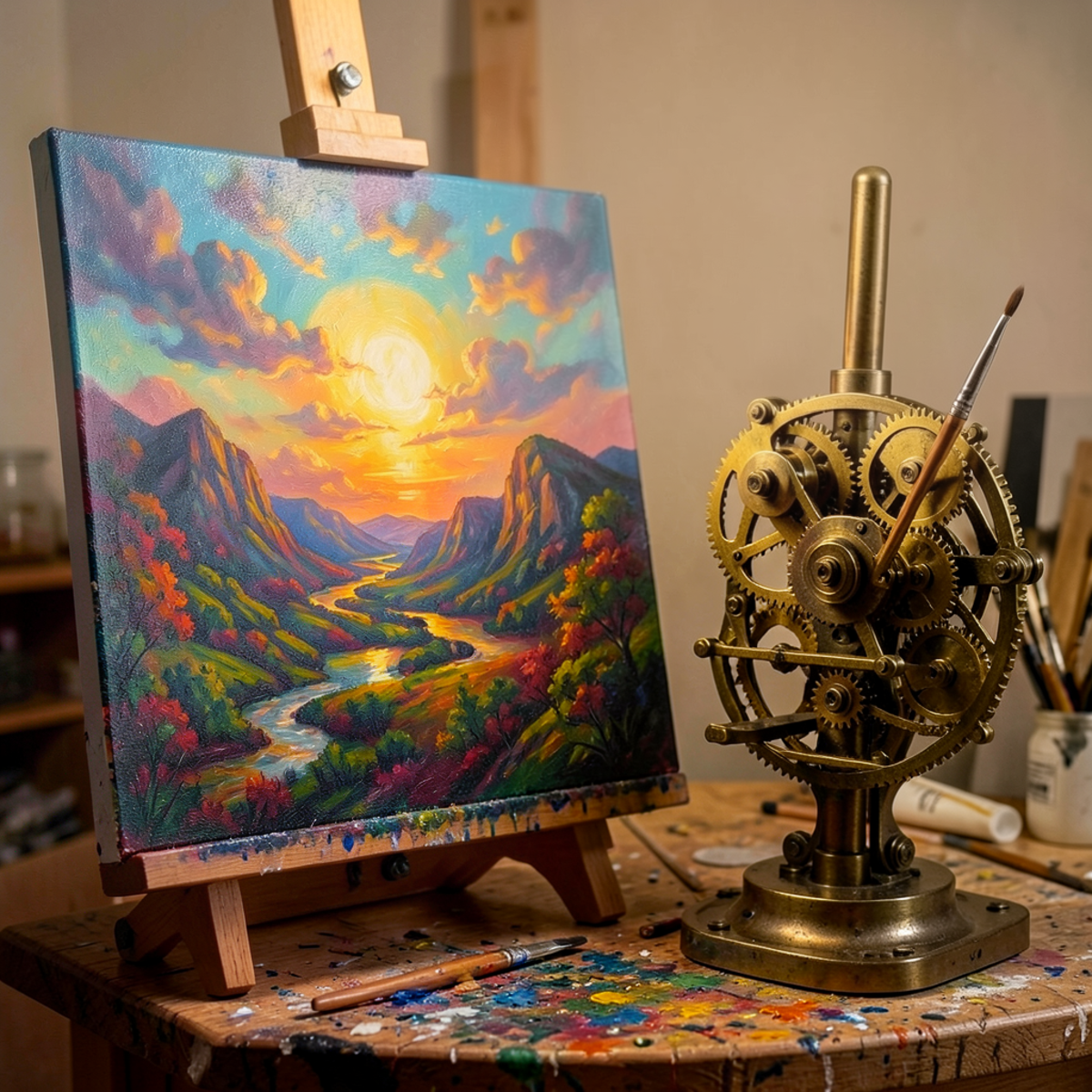
In September 2022, an image called "Théâtre D'opéra Spatial" won first place in the Digital Arts category at the Colorado State Fair fine arts competition. The piece depicted a futuristic royal court in a style that evoked classical oil painting. It was generated using Midjourney, a text-to-image AI system, by a digital artist named Jason Allen who tested hundreds of prompt iterations and performed post-processing in Photoshop.[1]
The reaction was immediate and intense. Artists felt cheated. The public debated whether AI-generated work could be "real" art. The U.S. Copyright Office later rejected copyright protection for the piece, ruling that Midjourney's role was too extensive for Allen to claim human authorship.[2]
But the philosophical question underneath the controversy is sharper than the legal or ethical ones. The judges, who didn't know the work was AI-generated, found it aesthetically compelling. It moved them. It won on its merits as a visual experience. The Chinese Room asks: does the absence of understanding in the creator change anything about the work itself?
The Intuition and Its Challenge
There's a strong intuition that genuine creativity requires understanding. You can't write a good poem about loss without understanding what loss feels like. You can't compose music that evokes longing without knowing something about longing. Creativity seems to require not just pattern matching but meaning, intention, experience, the very things the Chinese Room argument says symbol manipulation cannot provide.
And yet. AI systems produce work that people find beautiful, moving, surprising, and insightful. Language models write poetry that readers find genuinely affecting. Image generators produce art that wins competitions. Music AI composes pieces that listeners can't distinguish from human composition. If the output is creative by any measure an audience can apply, does the inner state of the creator matter?
Searle's thought experiment translates directly here. The person in the Chinese Room could, given sufficiently complex rules, produce a poem in Chinese that native speakers find beautiful. They don't understand the poem. They don't know what it's about. They don't feel what it expresses. But the poem exists, and it works as a poem. Is it less beautiful because its producer didn't understand it?
Three Kinds of Creativity
The philosopher and cognitive scientist Margaret Boden offers a framework that helps sharpen the question. Boden identifies three types of creativity: combinational, exploratory, and transformational.[3]
Combinational creativity produces novel combinations of familiar ideas. A metaphor that links heartbreak to a winter landscape. A musical mashup that juxtaposes two genres. A joke that connects two unrelated domains. The novelty is in the combination, not in the components.
Exploratory creativity works within an established style or conceptual space, pushing its boundaries and discovering possibilities that were always latent but hadn't been found. A jazz musician exploring the space of possible improvisations within a chord structure. An architect finding new forms within the constraints of a material. The creativity is in the exploration, not in changing the rules.
Transformational creativity changes the rules of the space itself. Cubism didn't explore the space of representational painting. It abandoned representational constraints and created a new space. Twelve-tone composition didn't push the boundaries of tonal harmony. It rejected tonality entirely. The creativity is in redefining what's possible.
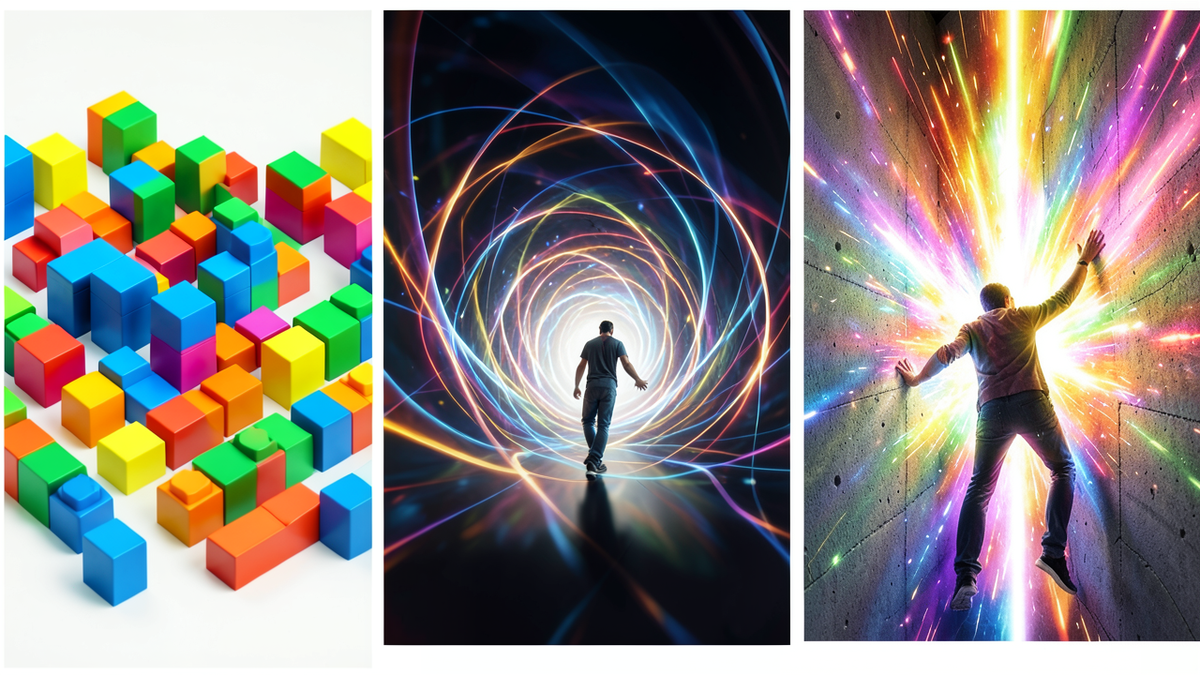
AI systems are demonstrably capable of combinational creativity. They produce novel combinations of ideas, styles, and elements that their training data contains separately but never put together in the same way. This is impressive but, as Boden notes, the most common and least mysterious form of creativity.
AI systems show some capacity for exploratory creativity. They can work within a style and produce variations that are novel within that space, pieces that a human working in the same style might not have found but that clearly belong to the genre. Whether this constitutes exploration or just very thorough sampling of the statistical space is a question the Chinese Room makes difficult to answer from outside.
Transformational creativity is harder to attribute to AI. Changing the rules of a conceptual space seems to require recognizing what the rules are and choosing to violate them. It requires a stance toward the space: dissatisfaction, boredom, a sense that the space has been exhausted. Can a system without understanding have a stance toward what it's doing? Can it be bored by the style it's been trained on?
The Intentionality Problem
Creativity, as humans experience it, involves intentionality: creating something for a reason, with a purpose, toward an effect. A poet chooses a word because of how it sounds, what it means, what it evokes. A painter places a brushstroke because of how it relates to the whole composition. The choices are meaningful to the creator.
AI systems make choices (in the sense that they select one output over alternatives), but whether these choices are meaningful to the system is exactly the question the Chinese Room raises. The model selects tokens that are statistically likely given the context. The selection produces work that has meaning for the reader. But did the selection have meaning for the model?
This creates an asymmetry between production and reception. The audience experiences the work as meaningful, beautiful, surprising. They project intentionality onto it because the work reads as intentional, the way good writing always reads as intentional. But if no intentionality existed in the production, is the audience's experience of meaningfulness sufficient? Or are they experiencing a kind of aesthetic illusion?
The Infinite Monkeys and the Spectrum
The "infinite monkeys" thought experiment (monkeys typing randomly would eventually produce Shakespeare) is sometimes invoked to dismiss AI creativity: the AI is just the monkeys, but faster. This analogy fails in important ways. The monkeys produce Shakespeare by accident, from random key presses. AI systems produce creative work through learned statistical patterns that capture genuine structure in human expression. The output isn't random. It reflects real patterns of meaning, emotion, and craft that exist in the training data.
But the analogy captures something real: there's a difference between producing something creative and being creative. The monkeys produce Hamlet without being writers. The question is where on the spectrum between random typing and Shakespeare AI actually falls, and whether the answer matters if the output is indistinguishable.
Perhaps the most honest framing is that creativity, like understanding, may not be binary. There might be a spectrum from pure random generation (the monkeys) through pattern-based production (current AI) through intentional expression (human creativity). Each point on the spectrum produces outputs with different relationships to meaning, intention, and understanding. We can debate where "real" creativity begins, but the debate may reveal more about our definition of creativity than about the systems we're evaluating.
The Market's Answer and Its Limits
The market has already rendered its verdict, or at least a preliminary one. AI-generated art, music, writing, and code are used commercially at scale. Advertising agencies use AI images. Musicians use AI-assisted composition. Developers ship AI-generated code. The market judges by output quality, not by the metaphysical status of the producer.
This pragmatic resolution is legitimate for many purposes. If the advertisement works, the client doesn't care whether the designer understood the brand. If the code compiles and passes tests, the product ships regardless of whether the assistant understood the architecture. Markets optimize for results, not for the inner life of the producer.
But there are domains where the market's answer feels insufficient. When we read a poem about grief and learn it was written by an AI that has never experienced grief, something shifts. The poem hasn't changed. The words are the same. But our relationship to it changes, because we thought we were encountering another consciousness's experience of suffering, and instead we're encountering a statistical pattern that mimics such an encounter.
Whether this shift is justified depends on what we think art is for. If art is about the experience of the audience, the source is irrelevant. If art is about communication between conscious beings, the source is everything. The Chinese Room doesn't tell us which view is correct. It tells us that the question is real, and that creative output alone can't answer it.
References
[1] Jason Allen's "Théâtre D'opéra Spatial" won first place in the Digital Arts/Digitally Manipulated Photography category at the 2022 Colorado State Fair. See Smithsonian Magazine, "Art Made With Artificial Intelligence Wins at State Fair," September 2022. https://www.smithsonianmag.com/smart-news/artificial-intelligence-art-wins-colorado-state-fair-180980703/
[2] The U.S. Copyright Office rejected Allen's copyright application in September 2023. See Ars Technica, "US rejects AI copyright for famous state fair-winning Midjourney art," September 2023. https://arstechnica.com/information-technology/2023/09/us-rejects-ai-copyright-for-famous-state-fair-winning-midjourney-art/
[3] Margaret Boden, The Creative Mind: Myths and Mechanisms, Routledge, 2004 (2nd edition). Boden identifies combinational, exploratory, and transformational creativity as the three fundamental forms. See also Boden, "Computer Models of Creativity," AI Magazine, 2009. https://www.researchgate.net/publication/220605190_Computer_Models_of_Creativity