Pascal's Wager and Climate Technology
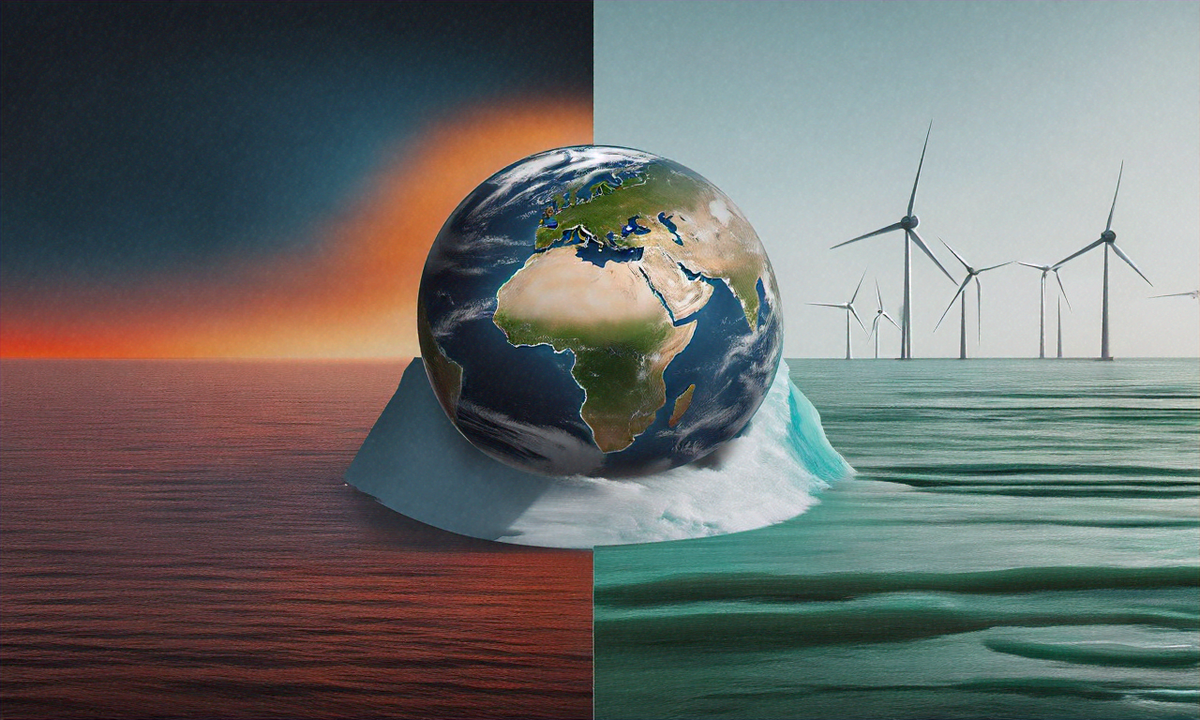
The planet is warming. The question isn't whether climate change is happening—it's whether we're willing to bet on preventing catastrophe. The probability of crossing irreversible tipping points is uncertain, but the outcome if we do is permanent. This is Pascal's Wager at planetary scale.
Unlike most risks, climate change offers no second chances. Once ice sheets collapse, once permafrost releases its methane, once ocean currents shift—these changes may be irreversible on human timescales.[1] The asymmetry is stark: the cost of action is measured in trillions of dollars, the cost of inaction in civilizational collapse.
The Wager's Structure
Climate technology investment presents a classic Pascal's Wager scenario. If we invest heavily in mitigation and adaptation, and climate change turns out less severe than feared, we've spent resources that could have gone elsewhere. But if we don't invest, and climate change proves catastrophic, the cost is potentially irreversible planetary harm.
The math seems clear: even if the probability of catastrophic outcomes is moderate, the magnitude of those outcomes—sea level rise displacing hundreds of millions, agricultural collapse, ecosystem destruction—justifies significant action. A 10% chance of losing coastal cities worldwide has massive expected negative value.
But this calculation assumes we can estimate probabilities accurately. Climate models provide ranges, not certainties. We're making trillion-dollar decisions based on projections that span from manageable to catastrophic. The uncertainty itself becomes part of the wager.
The Irreversibility Problem
What makes climate change a particularly stark Pascal's Wager is irreversibility. Many climate tipping points, once crossed, can't be undone on human timescales.[2] The Greenland ice sheet, if it melts, won't refreeze for millennia. Permafrost carbon, once released, can't be recaptured at scale. Ocean acidification can't be quickly reversed.
This irreversibility changes the risk calculation. With reversible risks, you can wait for more information, then course-correct. With irreversible risks, by the time you're certain, it's too late. The precautionary principle applies with full force: better to act on uncertain information than to wait for certainty that comes after the point of no return.
The challenge is that prevention is expensive and invisible. If we successfully avoid tipping points, we'll never know for certain whether they would have occurred. Success looks like nothing happening—a hard sell for trillion-dollar investments.
The Technology Bets
Climate technology spans multiple Pascal's Wagers, each with different risk profiles:
Renewable energy represents a relatively safe bet. Solar and wind costs have dropped dramatically, making them economically competitive even without climate considerations. If climate change proves less severe, we still have cleaner, cheaper energy. The downside is limited.
Carbon capture technology is a riskier wager. It's expensive, energy-intensive, and unproven at scale. If it works and we need it, it could be crucial. If it doesn't work, or if we don't need it, we've invested billions in infrastructure that provides little value. But the potential upside—removing legacy carbon from the atmosphere—could be transformative.
Geoengineering presents a meta-wager: a risky intervention to prevent a risky outcome. Solar radiation management—reflecting sunlight to cool the planet—could work quickly and cheaply. But it carries unknown risks: regional climate disruption, ozone depletion, termination shock if stopped suddenly. It's a Pascal's Wager within a Pascal's Wager: bet on a dangerous solution to a dangerous problem.
The Moral Hazard
One danger of framing climate action as Pascal's Wager is moral hazard: the temptation to bet on future technology rather than present action. If we assume carbon capture or geoengineering will save us, we may delay emissions reductions. This is betting on a bet—assuming the wager will pay off so we don't need to hedge.
The problem is that future technology is uncertain. Carbon capture may not scale. Geoengineering may prove too risky. Betting on technological salvation while continuing emissions is like doubling down on a risky hand. If the technology doesn't materialize, we've made the original problem worse.
This creates a dilemma: invest in mitigation (reducing emissions) or adaptation (preparing for impacts) or technological solutions (carbon capture, geoengineering)? Resources are finite. Spending on one means less for others. Pascal's Wager doesn't tell us how to allocate—only that we should act.
The Intergenerational Dimension
Climate change adds a temporal dimension to Pascal's Wager: the people making the bet (current generations) aren't the ones who will primarily bear the consequences (future generations). This creates a moral asymmetry beyond the mathematical one.
Standard economic analysis discounts future costs—a dollar of harm in 50 years is worth less than a dollar of harm today.[3] But should we discount existential or civilizational risks? Is it ethical to impose irreversible harm on future generations to avoid present costs?
This is where Pascal's Wager meets intergenerational ethics. If the potential outcome is permanent degradation of the planet's habitability, can we justify inaction based on uncertain probabilities? Future generations can't consent to the wager we're making on their behalf.
The Collective Action Problem
Unlike individual Pascal's Wagers, climate change requires global coordination. One country's emissions reductions are undermined by another's increases. The wager only pays off if enough actors participate.
This creates a meta-problem: should you take Pascal's Wager if you're uncertain others will? If you invest in climate action but other nations don't, you've paid the cost without securing the benefit. The wager becomes conditional on collective action.
International agreements like the Paris Accord attempt to solve this coordination problem. But enforcement is weak, and commitments are voluntary. We're collectively making a Pascal's Wager while uncertain whether we're all betting the same way.
The Cost of Being Wrong
The asymmetry of Pascal's Wager is clearest when we consider the cost of being wrong in each direction:
If we over-invest in climate action and the problem proves less severe, we've spent trillions on renewable energy, efficiency improvements, and carbon reduction. These investments may still provide benefits—cleaner air, energy independence, technological innovation—even if climate impacts are moderate.
If we under-invest and the problem proves catastrophic, we face sea level rise displacing hundreds of millions, agricultural disruption threatening food security, ecosystem collapse, and potential civilizational instability.[4] These outcomes are irreversible and potentially existential.
The asymmetry suggests erring on the side of action. But how much action? At what cost? Pascal's Wager tells us to take the bet, but not how much to wager.
Living with Uncertainty
Climate change presents Pascal's Wager in its most challenging form: uncertain probabilities, irreversible outcomes, intergenerational consequences, and collective action requirements. We must make trillion-dollar decisions with incomplete information, knowing that by the time we have certainty, it may be too late.
The question isn't whether climate change is a Pascal's Wager—it clearly is. The question is whether we're wise enough to take it seriously. Whether we're willing to invest in prevention despite uncertainty. Whether we can coordinate globally on a problem that transcends borders and generations.
Pascal's insight was that when potential outcomes are extreme, we can't simply wait for certainty. We must act despite uncertainty, weighing the asymmetry of outcomes against the cost of precaution. Climate change is the ultimate test of whether we've learned that lesson.
The planet is the wager. The stakes are civilizational. And we're all betting, whether we realize it or not.
References
[1] IPCC, "Climate Change 2023: Synthesis Report," Intergovernmental Panel on Climate Change, 2023. https://www.ipcc.ch/report/ar6/syr/
[2] Timothy M. Lenton et al., "Climate tipping points—too risky to bet against," Nature, Vol. 575, 2019. https://www.nature.com/articles/d41586-019-03595-0
[3] William Nordhaus, "The Climate Casino: Risk, Uncertainty, and Economics for a Warming World," Yale University Press, 2013. https://www.amazon.com/Climate-Casino-Uncertainty-Economics-Warming/dp/1664478159
[4] Gernot Wagner and Martin L. Weitzman, "Climate Shock: The Economic Consequences of a Hotter Planet," Princeton University Press, 2015. https://www.amazon.com/Climate-Shock-Economic-Consequences-Hotter/dp/0691171327