Pascal's Wager: When Infinity Changes Everything
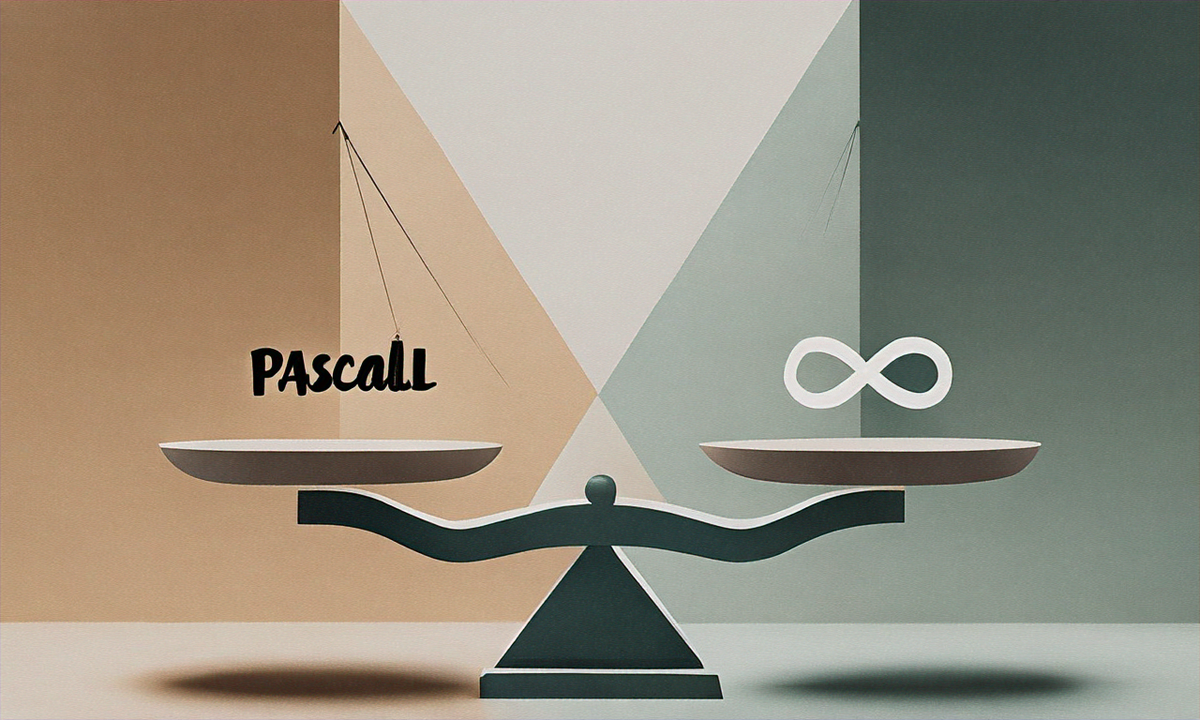
In 1670, French philosopher and mathematician Blaise Pascal proposed an argument that would echo through centuries: even if you're uncertain whether God exists, you should bet on belief. The reasoning was simple but profound. If God exists and you believe, you gain infinite reward (heaven). If God exists and you don't believe, you face infinite loss (hell). If God doesn't exist, the stakes are finite either way—you've lost some time and freedom, or gained some freedom but missed nothing eternal.
The math seemed clear: when one outcome involves infinity, finite costs become irrelevant. Better to believe and be wrong than disbelieve and face eternal consequences.
Pascal's Wager wasn't really about religion. It was about decision-making under uncertainty when the stakes are asymmetric—when potential outcomes are so extreme that normal risk calculations break down. And in the 21st century, we face more Pascal's Wagers than ever before.
The Logic of Asymmetric Risk
Pascal's argument rests on expected value—the probability of an outcome multiplied by its value. Normally, you calculate expected value by weighing probabilities against payoffs. A 50% chance of winning $100 has an expected value of $50. A 1% chance of winning $10,000 also has an expected value of $100.
But what happens when one outcome is infinite? Even a tiny probability multiplied by infinity yields infinity. A 0.001% chance of infinite reward still has infinite expected value. The math breaks down—or rather, it points toward a conclusion that seems absurd: you should take any action, no matter how costly, to avoid even the smallest probability of infinite harm or to gain even the smallest probability of infinite reward.
This is both Pascal's insight and his problem. The logic is mathematically sound but practically paralyzing. If we took every tiny probability of catastrophic outcome seriously, we'd be unable to act at all.
The Original Wager and Its Critics
Pascal's Wager has faced centuries of philosophical criticism:
The many-gods objection: What if you're betting on the wrong god? If there are multiple possible deities with different requirements, believing in one might anger another. You can't hedge all bets simultaneously.
The authenticity problem: Can you choose to believe? Pascal's Wager requires genuine belief, not just going through motions. But belief isn't typically voluntary—you can't simply decide to believe something you find implausible.
The false dichotomy: Pascal presented two options (believe or don't), but reality offers many gradations. What about agnosticism? What about different intensities of belief? What about believing in God but not organized religion?
The moral objection: Is it ethical to believe something purely for self-interested reasons rather than because you think it's true? Does this reduce faith to a calculated bet rather than genuine conviction?
These criticisms are valid, but they miss something important: Pascal wasn't primarily making a theological argument. He was exploring how we make decisions when outcomes are extreme and probabilities are uncertain. And that question has become urgently practical.
When Technology Creates Infinite Stakes
Technology has given us scenarios where Pascal's logic applies without the theological baggage:
Existential risks: Small probabilities of human extinction or permanent civilizational collapse. Even if the probability is low, the outcome is so catastrophic that it may warrant significant action.
Irreversible changes: Climate tipping points, species extinction, loss of cultural knowledge. Once crossed, these thresholds can't be undone. The asymmetry between action and inaction becomes stark.
Cascading failures: Critical infrastructure dependencies where a single failure could trigger widespread collapse. The probability may be small, but the consequences could be civilization-threatening.
Long-term lock-in: Decisions that constrain future options for generations. AI alignment, genetic engineering, space colonization—choices made now could determine humanity's trajectory for centuries.
In each case, we face Pascal's dilemma: uncertain probabilities, extreme outcomes, and the question of how much to invest in prevention or preparation.
The Precautionary Principle
Pascal's Wager is closely related to the precautionary principle: when an action might cause severe or irreversible harm, the burden of proof falls on those taking the action, even if cause-and-effect relationships aren't fully established.
This principle underlies much environmental and safety regulation. We don't wait for absolute proof that a chemical causes cancer before restricting it. We don't require certainty that climate change will be catastrophic before taking action. The potential harm is severe enough that uncertainty doesn't justify inaction.
But the precautionary principle faces the same challenge as Pascal's Wager: where do you draw the line? Every action has some tiny probability of catastrophic consequences. If we're paralyzed by every possible risk, we can't function. Yet if we ignore low-probability catastrophic risks, we may face disasters we could have prevented.
The Problem of Many Wagers
Perhaps the most challenging aspect of applying Pascal's logic to technology is that we face multiple potential catastrophes simultaneously:
- AI existential risk
- Climate change
- Pandemics (natural and engineered)
- Nuclear war
- Asteroid impacts
- Supervolcano eruptions
- Antibiotic resistance
- Ecosystem collapse
Each could be framed as a Pascal's Wager. Each involves uncertain probability and potentially catastrophic outcomes. But we have finite resources. We can't maximize prevention of every possible catastrophe.
How do we prioritize when multiple outcomes are potentially catastrophic? Pascal's math doesn't help—infinity equals infinity. We need additional criteria: probability estimates, tractability (can we actually do anything?), neglectedness (are others already addressing it?), and time horizons.
Expected Value vs. Robust Decision-Making
Some decision theorists argue we should abandon expected value calculations entirely when dealing with extreme outcomes and deep uncertainty. Instead, they propose "robust decision-making"—choosing strategies that perform reasonably well across many possible futures rather than optimizing for expected value.
This approach acknowledges that our probability estimates for rare, extreme events are often unreliable. We don't know the probability of AI causing human extinction because we've never built artificial general intelligence. We don't know the probability of crossing irreversible climate tipping points because we've never run this experiment before.
Rather than pretending we can calculate expected values with precision, robust decision-making focuses on resilience, adaptability, and preserving options. It's less about betting on specific outcomes and more about building systems that can handle many possible futures.
The Wisdom and Folly of Pascal's Wager
Pascal's Wager teaches us something important: when potential outcomes are extreme, normal risk calculations fail. We can't simply multiply probabilities by payoffs and optimize. The math breaks down, and we need different frameworks.
But Pascal's Wager also reveals the limits of pure logic in decision-making. We can't act on every tiny probability of catastrophe. We can't hedge every bet. We can't optimize for infinite outcomes with finite resources.
What we can do is recognize when we're facing asymmetric risks—when the cost of being wrong in one direction vastly exceeds the cost of being wrong in the other. When irreversibility matters. When small probabilities meet catastrophic outcomes. When our choices today constrain options for future generations.
The Stakes of Our Wagers
Technology has made Pascal's thought experiment practical. We're not debating theological abstractions—we're making real decisions about AI safety, climate policy, pandemic preparedness, and existential risk. Each involves uncertain probabilities and potentially catastrophic outcomes.
The question isn't whether to take Pascal's Wager. We're already taking it, every day, through action or inaction. The question is: which wagers deserve our finite resources, attention, and commitment?
Over the next week, we'll explore specific Pascal's Wagers in technology: AI existential risk, climate change, cybersecurity, pandemic preparedness, and asteroid defense. Each presents the same fundamental challenge—how to act wisely when facing uncertain probabilities and extreme outcomes.
Pascal's insight remains relevant 350 years later: when infinity enters the equation, everything changes. The question is whether we're wise enough to act on that insight without being paralyzed by it.
References
[1] Blaise Pascal, Pensées, 1670. Section 233 (Lafuma numbering). https://www.gutenberg.org/ebooks/18269
[2] Alan Hájek, "Pascal's Wager," Stanford Encyclopedia of Philosophy, 2018. https://plato.stanford.edu/entries/pascal-wager/
[3] Nick Bostrom, "Existential Risk Prevention as Global Priority," Global Policy, Vol. 4, Issue 1, 2013. https://www.existential-risk.org/concept.html