Social Media as the Cave: Curated Lives and Performed Reality
Consider a thought experiment. You're invited to a dinner party where every guest has been asked to share one story from their week. Naturally, people choose their best moments: the promotion, the vacation, the funny anecdote. Nobody mentions the argument with their partner, the anxiety at 2 AM, or the afternoon spent staring at a wall. By the end of the evening, everyone else's week sounds wonderful. Yours, which you lived in full unedited detail, feels ordinary by comparison.
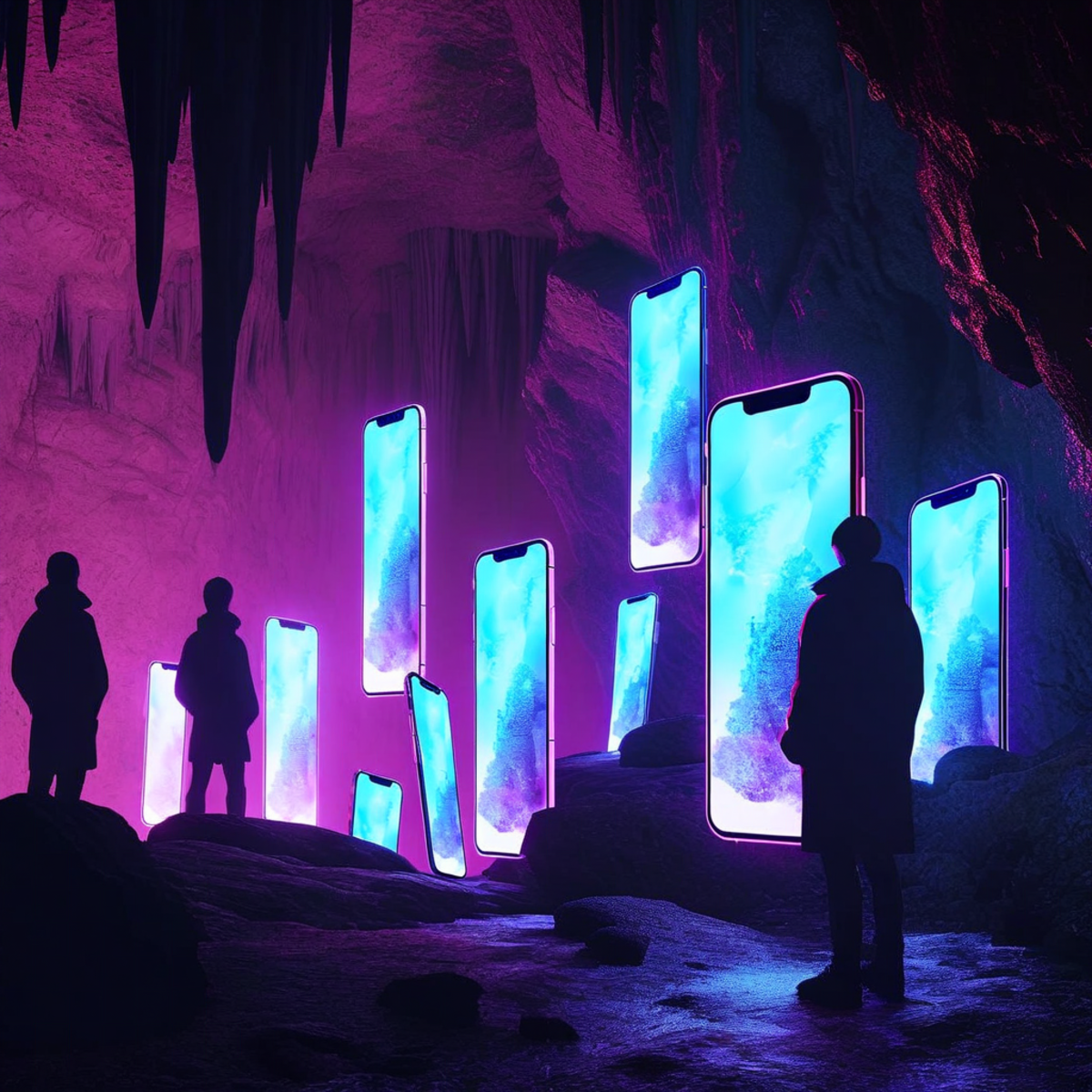
Now imagine that dinner party runs 24 hours a day, with millions of guests, and you attend it through a screen in your pocket. That's social media. And it's one of the most effective caves humanity has ever built.
The Highlight Reel
Social media doesn't show you people's lives. It shows you what people choose to present as their lives. The distinction matters more than most users realize.
A vacation photo doesn't include the argument at the airport. A career announcement doesn't mention the months of rejection letters. A fitness post doesn't show the days when motivation disappeared entirely. What appears on the feed is a highlight reel, a selection of moments curated to project a particular image. The mundane, the difficult, the unflattering: these get edited out before posting.
This is Plato's Cave with a twist. In the original allegory, the prisoners watch shadows cast by objects they can't see. On social media, the objects themselves are performing. People don't just passively cast shadows; they carefully shape and direct them. The shadow is the product.[1]
Research on social comparison theory, first proposed by Leon Festinger in 1954, suggests that humans naturally evaluate themselves by comparing to others.[2] Social media industrializes this process. Instead of comparing yourself to the handful of people in your immediate environment, you compare yourself to thousands of curated personas, each presenting their most polished moments. The comparison is between your behind-the-scenes footage and everyone else's final cut.
The Double Cave
The more interesting philosophical problem isn't that you're watching shadows. It's that you're also casting them.
Every social media user occupies a dual role: consumer of others' curated content and producer of their own. You scroll through polished representations of other people's lives while simultaneously constructing a polished representation of yours. Nobody in this system sees reality. The viewers see curated content. The creators know their own posts are curated but often forget that everyone else's are too.
Professional content creators take this to its logical extreme. Influencer culture is, at its core, professional shadow-casting. The "candid" morning routine was filmed three times with professional lighting. The "spontaneous" travel photo required forty-seven takes. The "authentic" vulnerability post was drafted, edited, and optimized for engagement before publishing.[3]
This creates what sociologist Erving Goffman might have recognized as a total institution of self-presentation.[4] Goffman argued in 1959 that all social interaction involves performance, that we present different versions of ourselves in different contexts. Social media collapses those contexts. Your coworkers, your family, your college friends, and complete strangers all see the same feed. The performance becomes permanent and universal.
Some users have responded by creating secondary accounts, sometimes called "finstas," where they post unfiltered content for a small circle of close friends.[5] Research has found that these secondary accounts deliberately maintain small audiences to avoid context collapse, creating spaces where humor, authenticity, and unfiltered self-expression are the norm.[6] The irony is telling: the "fake" account is where people are real, and the "real" account is where they perform.
The Algorithm's Cave Within the Cave
The curation problem goes deeper than individual choice. Platform algorithms add another layer of mediation between users and reality.
Algorithms select which posts appear in your feed based on predicted engagement. Content that provokes strong emotional reactions, whether positive or negative, tends to generate more interaction and therefore gets amplified. Research has shown that content expressing moral outrage spreads faster and further than neutral content.[7] The algorithm doesn't show you a representative sample of what people post. It shows you what's most likely to keep you scrolling.
This means the shadows on your cave wall aren't even a random selection of other people's curated content. They're a further curation, optimized for engagement rather than accuracy. You see the most extreme, the most provocative, the most emotionally charged versions of already-curated lives.
The result is a distorted picture that feels comprehensive. Users typically report believing they have a good sense of what's happening in their social circles and in the world, even when research suggests their algorithmically curated feed gives them a systematically skewed view.[8]
The Mental Health Shadow
The psychological costs of living in this particular cave have been studied extensively, though the findings are more nuanced than headlines suggest.
Large-scale studies have found correlations between heavy social media use and increased rates of anxiety, depression, and loneliness, particularly among adolescents.[9] The causal mechanisms are debated, but social comparison appears to play a significant role. When your primary reference point for "normal" is a curated feed of highlights, your own unedited life can feel inadequate by comparison.
The "digital detox" movement offers an interesting parallel to Plato's freed prisoner. People who step away from social media for extended periods often report an initial period of discomfort, a feeling of missing out, of being disconnected, followed by a gradual recalibration. They start noticing things they'd stopped seeing. Conversations feel different. Time moves differently. The experience is disorienting before it becomes clarifying.
This mirrors Plato's description almost exactly. The freed prisoner, upon first seeing the fire and then the sunlight, is blinded and confused. The real world is overwhelming after the simplicity of shadows. But gradually, vision adjusts. The prisoner sees things as they are, not as they were projected on the wall.
Seeing Past the Feed
The Brain in a Vat series explored filter bubbles, the way algorithms hide information from you. Social media as cave is a different problem. It's not about what's hidden from you. It's about what people voluntarily distort about themselves, and how that distortion becomes the environment you inhabit.
A few things help maintain perspective:
Remember the editing. Every post you see went through a selection process. Someone chose this moment, this angle, this caption from among many alternatives. The post is a shadow, not the life.
Notice your own curation. Pay attention to the gap between your experience and what you post about it. That gap exists for everyone else too. Your awareness of your own performance can remind you that others are performing as well.
Seek unmediated connection. Conversations that happen in person, without an audience, without the possibility of likes or shares, operate by different rules. They're messier, less polished, and closer to reality.
Question the feed's representativeness. What you see is not a random sample. It's algorithmically selected to maximize your engagement. The emotional tone of your feed says more about the algorithm than about the world.
Plato's prisoners believed the shadows were real because shadows were all they knew. Social media users face a subtler version of the same trap. They know, intellectually, that feeds are curated. But the knowledge doesn't always translate into felt experience. The feed still feels like a window onto reality, even when you know it's a wall of shadows.
The cave is comfortable. The shadows are entertaining. And unlike Plato's prisoners, we walked in voluntarily. That might make it harder to leave, but it also means the exit is always there.
We just have to remember it exists.
References
[1] Jia Tolentino, Trick Mirror: Reflections on Self-Delusion, Random House, 2019.
[2] Leon Festinger, "A Theory of Social Comparison Processes," Human Relations, Vol. 7, No. 2, 1954. https://doi.org/10.1177/001872675400700202
[3] Taylor Lorenz, "The Influencer Aesthetic Is Over," The Atlantic, April 23, 2019. https://www.theatlantic.com/technology/archive/2019/04/influencers-are-abandoning-instagram-look/587803/
[4] Erving Goffman, The Presentation of Self in Everyday Life, Anchor Books, 1959.
[5] Rosalie Gillett, "How teens use fake social media accounts to relieve the pressure of perfection," The Conversation, March 6, 2018. https://theconversation.com/how-teens-use-fake-instagram-accounts-to-relieve-the-pressure-of-perfection-92105
[6] Sijia Xiao et al., "Finsta: Creating 'Fake' Spaces for Authentic Performance," Extended Abstracts of the 2020 CHI Conference on Human Factors in Computing Systems, ACM, 2020. https://www.researchgate.net/publication/332770842_Finsta_Creating_Fake_Spaces_for_Authentic_Performance
[7] William J. Brady et al., "Emotion shapes the diffusion of moralized content in social networks," Proceedings of the National Academy of Sciences, Vol. 114, No. 28, July 2017. https://doi.org/10.1073/pnas.1618923114
[8] Eytan Bakshy, Solomon Messing, and Lada A. Adamic, "Exposure to ideologically diverse news and opinion on Facebook," Science, Vol. 348, No. 6239, June 2015. https://doi.org/10.1126/science.aaa1160
[9] Jean M. Twenge et al., "Increases in Depressive Symptoms, Suicide-Related Outcomes, and Suicide Rates Among U.S. Adolescents After 2010 and Links to Increased New Media Screen Time," Clinical Psychological Science, Vol. 6, No. 1, 2018. https://doi.org/10.1177/2167702617723376