Plato's Cave: The Allegory That Predicted the Digital Age
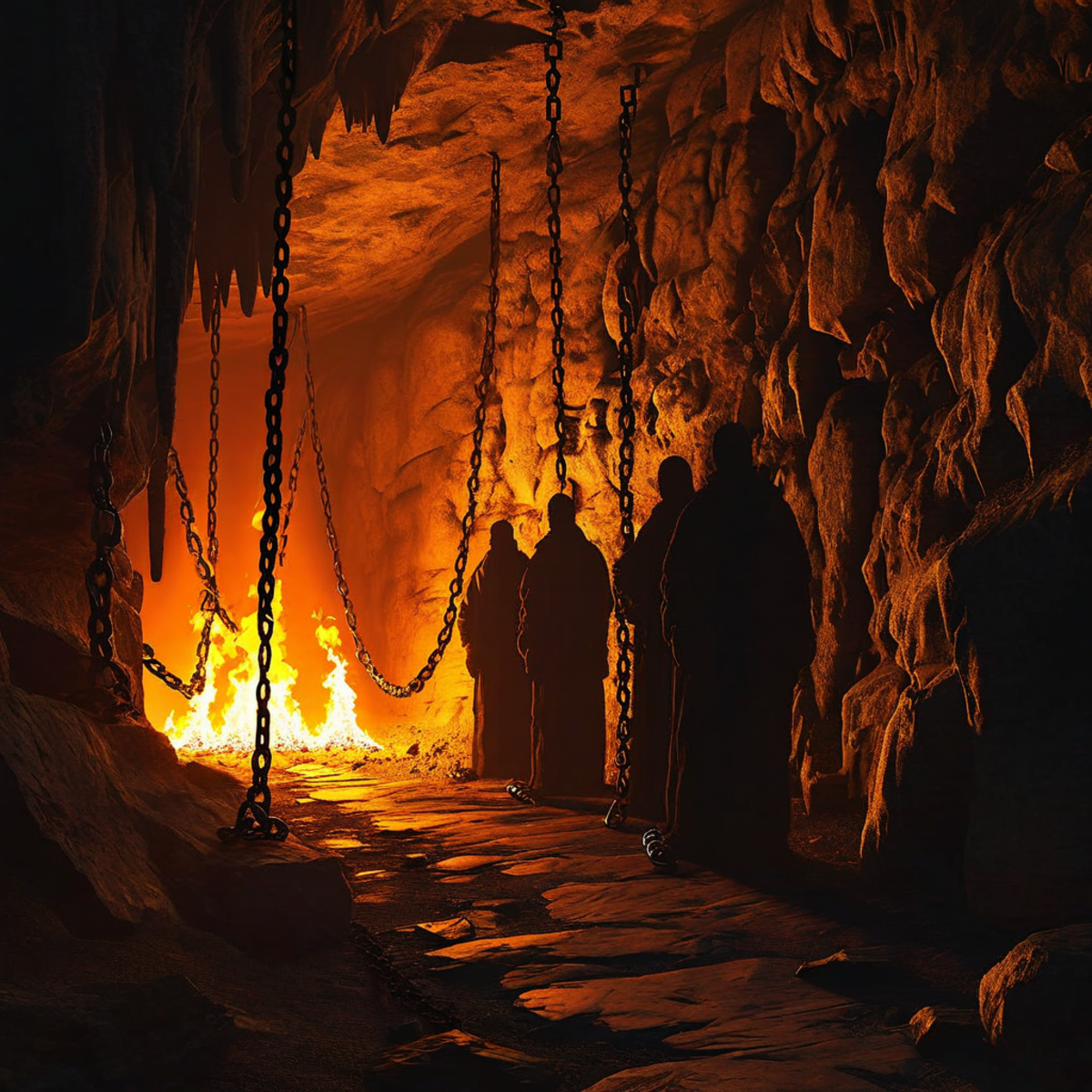
Imagine spending your entire life in a dark room, watching shadows flicker across a wall. You've never seen the objects casting those shadows, never felt sunlight, never turned around. The shadows are all you know. To you, they are reality.
Around 375 BCE, Plato described this scenario in Book VII of The Republic. Prisoners are chained in a cave from birth, facing a blank wall. Behind them, a fire burns, and between the fire and the prisoners, people carry objects along a raised walkway. The prisoners see only the shadows these objects cast on the wall. They hear echoes and attribute them to the shadows. They name the shadows, study their patterns, and build an entire understanding of reality based on projections of things they've never directly encountered.
Then one prisoner is freed.
The Painful Journey Toward Reality
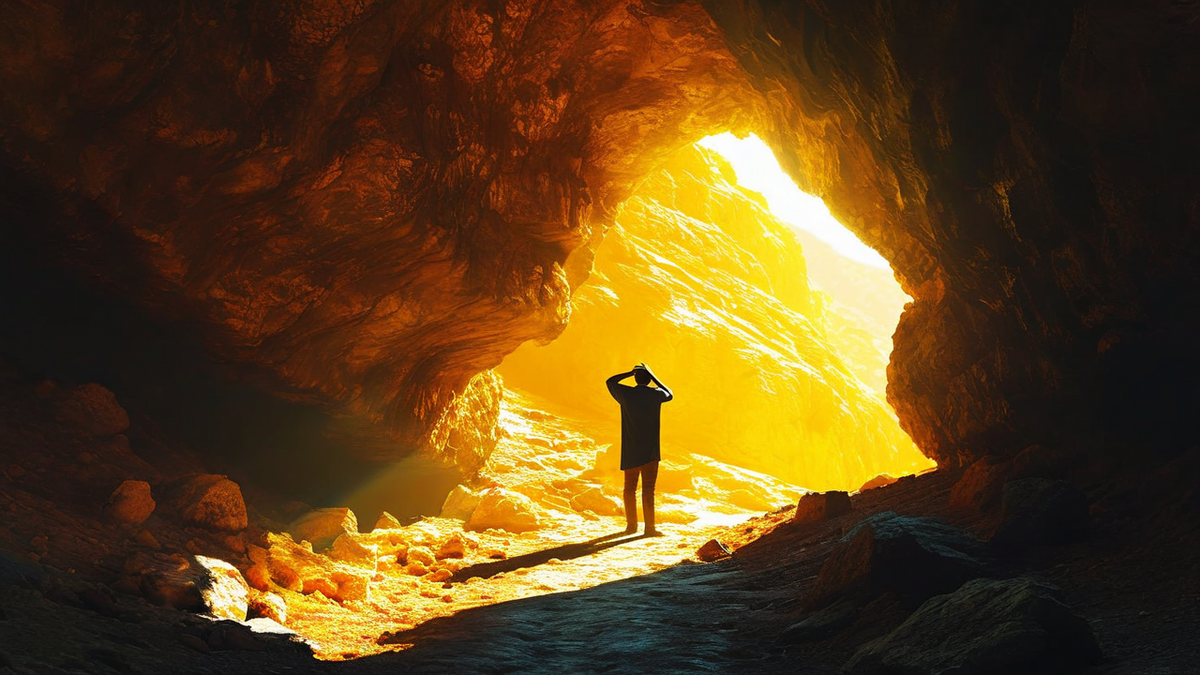
The freed prisoner turns around and sees the fire for the first time. It's blinding, painful. The objects being carried look strange and unfamiliar. He's told these are more real than the shadows he's watched his whole life, but he doesn't believe it. The shadows were crisp and clear. These new shapes are confusing.
Then he's dragged out of the cave entirely. The sunlight is overwhelming. Gradually, his eyes adjust. He sees reflections in water, then objects themselves, then the sun, the source of all light and visibility. He realizes the shadows were pale imitations of a richer, more complex reality.
Plato used this allegory to illustrate his theory of Forms: the idea that the physical world we perceive is itself a kind of shadow, an imperfect copy of ideal, abstract realities. The chair you're sitting on is a shadow of the Form of "chair." The justice you experience in courts is a shadow of the Form of "justice." True knowledge means grasping the Forms themselves, not their material reflections.
But you don't need to accept Plato's metaphysics to find the allegory powerful. The core insight is simpler and more universal: we routinely mistake representations for the things they represent.
The Map Is Not the Territory
In 1931, Alfred Korzybski coined a phrase that captures Plato's insight in modern terms: "the map is not the territory." A map is useful precisely because it simplifies. It leaves things out. But if you forget that the map is a simplification, you start treating it as if it were the territory itself.
This is what Plato's prisoners do. They treat shadows (representations) as if they were the objects (reality). They don't even know they're looking at representations because they've never seen anything else.
Plato identified four stages of knowledge, each representing a deeper understanding of reality. At the lowest level, eikasia, we accept images and shadows at face value. At pistis, we recognize physical objects as real but don't question deeper. At dianoia, we reason abstractly, using mathematics and logic. At noesis, we grasp the Forms directly through philosophical insight.
Most of us, Plato suggested, spend our lives somewhere in the first two stages. We accept what we see without questioning the layers of mediation between us and reality.
Why Technology Builds New Caves
Plato couldn't have imagined the internet, dashboards, social media feeds, or AI-generated content. But his allegory describes our technological situation with uncomfortable precision.
We experience the world increasingly through representations. A manager watches a dashboard instead of walking the factory floor. A developer interacts with an API instead of understanding the system beneath it. A teenager compares their life to curated Instagram posts instead of the messy reality behind them. A student asks an AI for answers instead of engaging with primary sources.
Each of these is a cave. The dashboard, the API, the feed, the AI summary: these are shadows on the wall. They represent something real, but they aren't the thing itself. And because they're convenient, clear, and always available, we often prefer them to the harder work of engaging with reality directly.
The Brain in a Vat series on this blog asked: "How do you know this is real?" That's a question about deception. Plato's Cave asks something different: "What are you missing by only seeing the representation?" It's a question about mediation, about the gap between the map and the territory, between the metric and the outcome, between the feed and the life.
Six Shadows on the Wall
Over the coming week, we'll explore six ways technology keeps us watching shadows:
How metrics become substitutes for the things they measure. How software abstraction layers hide the reality beneath them. How social media replaces authentic life with curated performance. How AI-generated content creates shadows of shadows. How maps, models, and simulations become more trusted than direct observation. And finally, how we might begin to see past the representations.
Plato's freed prisoner discovered that leaving the cave was painful. The sunlight hurt. The real world was messier and more complex than the neat shadows on the wall. The other prisoners thought he was crazy when he tried to tell them what he'd seen.
Twenty-four centuries later, we're still in the cave. We've just built much better walls.
References
[1] Plato, The Republic, Book VII, c. 375 BCE. Translated by Benjamin Jowett. Available at: https://classics.mit.edu/Plato/republic.8.vii.html
[2] Alfred Korzybski, "A Non-Aristotelian System and its Necessity for Rigour in Mathematics and Physics," paper presented at the American Mathematical Society, 1931. Reprinted in Science and Sanity, 1933.