If You Replace Every Plank, Is It the Same Ship?
You own a favorite tool—a hammer, a guitar, a pocket knife. Over the years, you replace the handle. Then the head. Then the grip. Every original part is gone. Is it still your tool?
This question has been asked for over two thousand years. It started with a ship, and it's never been answered. But today, every software engineer, every open source maintainer, every platform architect faces a version of it—whether they realize it or not.
Plutarch's Ship
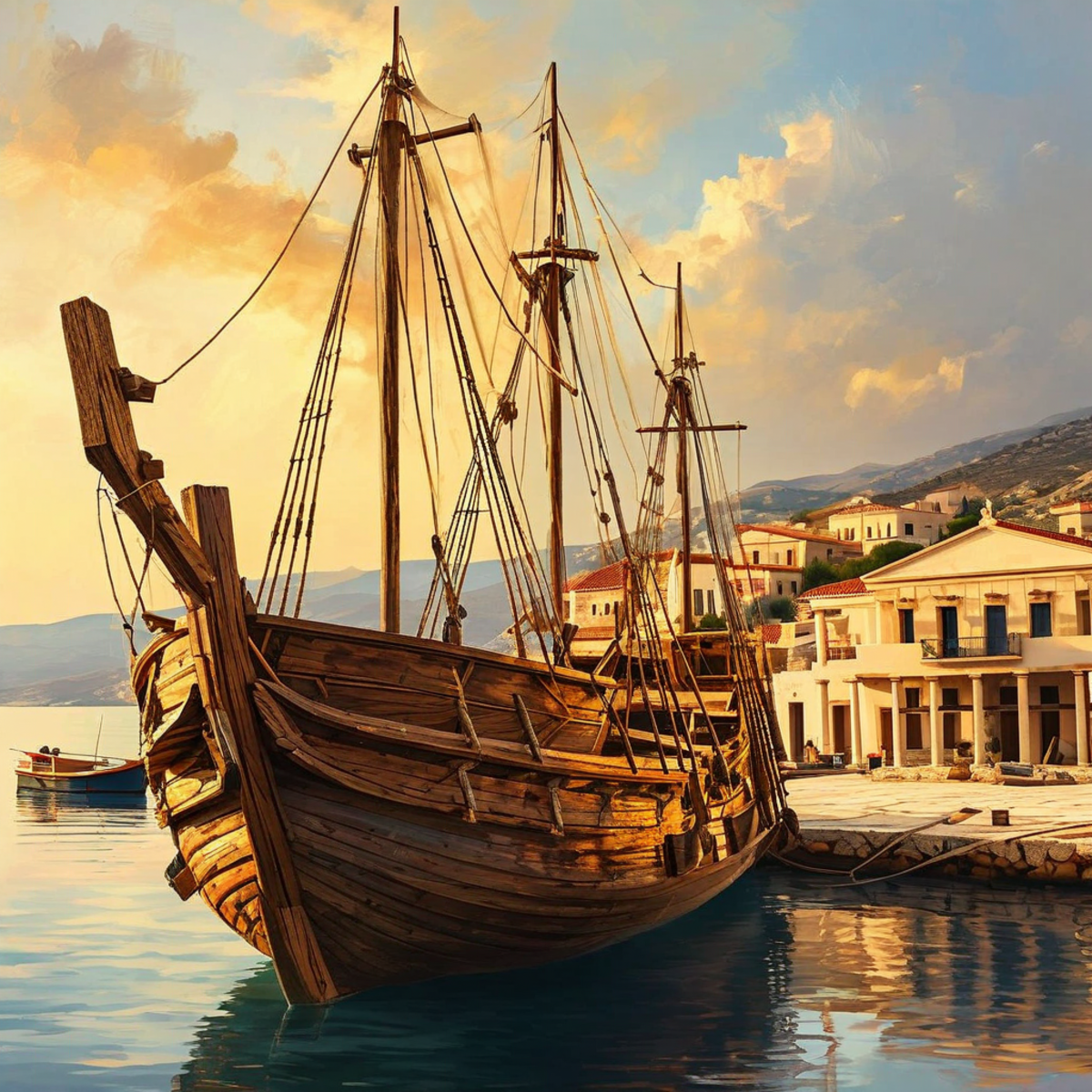
The Greek historian Plutarch, writing in the first century CE, described a ship preserved in Athens—the ship that Theseus supposedly sailed back from Crete after slaying the Minotaur.[1] The Athenians maintained it as a monument, replacing rotting planks with new timber as the years passed.
Eventually, every plank had been replaced. Philosophers began to argue: was it still the Ship of Theseus?
The question seems simple. The answer isn't.
If you say yes—it's still the same ship—then identity doesn't depend on material. The ship is something beyond its wood. But what? Its shape? Its function? The story people tell about it?
If you say no—it's a different ship—then at what point did it change? Which plank was the one that tipped it from "same" to "different"? You can't point to a single replacement and say "that's where identity was lost."
Hobbes Raises the Stakes
In the seventeenth century, Thomas Hobbes added a twist that made the problem worse.[2] Suppose someone collected all the old planks as they were removed and built a second ship from them. Now you have two ships: the one in the harbor with all new wood, and the one built from the original material.
Which one is the Ship of Theseus?
The harbor ship has continuity—it was never disassembled, never stopped being a ship. The rebuilt ship has the original material—every plank that Theseus actually touched.
Both have a legitimate claim. Neither has a complete one.
Four Ways to Think About Identity
Philosophers have developed several frameworks for thinking about what makes something "the same thing" over time.
Material identity says the thing is its stuff. The ship is its planks. Replace the planks, lose the ship. This is intuitive but problematic—your body replaces most of its cells over roughly seven to ten years, yet you're still you.
Spatiotemporal continuity says identity follows the continuous path through space and time. The harbor ship is the "real" one because it was never disassembled. It has an unbroken history. This handles gradual change well but struggles with forks—what happens when two things both have continuous histories branching from the same origin?
Functional identity says the thing is what it does. If it sails like Theseus's ship, carries cargo like Theseus's ship, and handles like Theseus's ship, it is Theseus's ship. This is practical but raises a question: if you build a perfect replica from scratch, is that also the same ship?
Narrative identity says the thing is the story we tell about it. Whichever ship the Athenians call "Theseus's ship" is the real one. Identity is a social agreement, not a physical fact. This is flexible but feels unsatisfying—surely identity is more than just a label?
Aristotle offered another lens through his four causes: the material cause (what it's made of), the formal cause (its structure), the efficient cause (who built it), and the final cause (its purpose).[3] The Ship of Theseus preserves its formal and final causes while losing its material and efficient ones. Whether that's enough depends on which causes you think matter most.
Why Technology Forces the Question
For most of history, the Ship of Theseus was a thought experiment—interesting to debate over wine, but not practically urgent. Technology changed that.
Software is replaced piece by piece constantly. Dependencies get updated. Modules get refactored. Entire codebases get rewritten line by line over years. At what point is it a different system?
Open source projects fork. The code splits, the community splits, sometimes the name splits. Two projects emerge from one. Which is the "real" project—the one with the original maintainers, or the one with the original code?
Cloud infrastructure is designed to be ephemeral. Servers spin up and down. Containers live for minutes. Nothing persists. If the system's identity doesn't live in any physical component, where does it live?
Your digital identity accumulates over decades—old code, old posts, old profiles. Your cells replace themselves, but your digital footprint doesn't. The old planks never decay online.
These aren't abstract puzzles. They determine real things: software versioning, licensing disputes, ownership claims, trust relationships, and billions of dollars in the case of blockchain forks.
Numerical vs. Qualitative Identity
Philosophers distinguish between two types of identity that are often confused in these debates.
Numerical identity asks: is this the same individual thing? Is the ship in the harbor the very same ship Theseus sailed? There can only be one answer—yes or no.
Qualitative identity asks: is this the same kind of thing? Does it have the same properties? Two ships can be qualitatively identical—same design, same materials, same function—without being numerically identical. They're the same type but different objects.
Technology blurs this distinction in ways the ancient Greeks couldn't have imagined. Software can be copied perfectly. A clone of a codebase is qualitatively identical to the original in every measurable way. The bits are the same. The behavior is the same. Yet we often treat the copy as different from the original—the fork isn't the project, the clone isn't the repo.
Why? Because we care about more than just properties. We care about history, continuity, and the story of how something got to where it is.
The Question Behind the Question
The Ship of Theseus doesn't really have a solution. That's what makes it a paradox rather than a problem.
But it reveals something important: identity isn't a fact waiting to be discovered. It's a decision we make based on what we value. When we ask "is it the same thing?" we're really asking "what matters to us about this thing?"
If you value material, the rebuilt ship wins. If you value continuity, the harbor ship wins. If you value function, both win. If you value narrative, whichever one people point to wins.
In technology, these decisions have consequences. Every time you version software, fork a project, migrate a system, or look at your own digital history, you're implicitly answering the Ship of Theseus. The question is whether you're making that answer intentionally.
Technology has turned an ancient thought experiment into a daily engineering decision. Every deploy is a plank being replaced. Every migration is a ship being rebuilt. Every fork is Hobbes's second ship taking shape from the old wood.
The ancient Greeks debated this over centuries. We face it every time we push to production.
References
[1] Plutarch, "Life of Theseus," Parallel Lives, 75 CE. https://penelope.uchicago.edu/Thayer/E/Roman/Texts/Plutarch/Lives/Theseus*.html
[2] Thomas Hobbes, De Corpore, Part II, Chapter 11, 1655.
[3] Aristotle, Physics, Book II, 350 BCE. https://classics.mit.edu/Aristotle/physics.2.ii.html