Does Time Flow? The A-Theory and B-Theory of Time

Right now feels special. This moment, the one you're reading these words in, has a quality that yesterday's moments have lost and tomorrow's haven't yet acquired. The past is fixed, the future is open, and the present is where you actually live. This is so obvious that it can seem strange to question it. Yet a century of debate in the philosophy of time has done exactly that, and the disagreement it produced (between what philosophers call the A-theory and the B-theory of time) turns out to matter for physics, for how we build software, and for how we think about our own lives.
The distinction traces to the British philosopher J.M.E. McTaggart, who in 1908 argued that we describe events in time in two fundamentally different ways.[1] The first way uses the notions of past, present, and future: the meeting is coming up, it is happening now, it is over. McTaggart called this the A-series. The second way uses only the relations earlier than, later than, and simultaneous with: the meeting is earlier than dinner and later than lunch, regardless of when "now" is. He called this the B-series. From this grew two rival views of what time fundamentally is.
Two Pictures of Time
The A-theory holds that the A-series is fundamental. Time genuinely passes. There is an objective, moving present, and the difference between past, present, and future is a real feature of the world, not just a feature of our perspective on it. On this view, the future is not yet real, or at least not settled, and the present has a special ontological status. Reality is dynamic. The flow of time is not an illusion but the deepest fact about existence.
The B-theory holds that the B-series is fundamental. The relations earlier-than and later-than are all there is to time. There is no objective "now" that moves; "now" is like "here," a term whose meaning depends on who is speaking and when. Every moment is equally real, just as every place is equally real even though you happen to be standing in one of them. On this view, often paired with a picture called the "block universe," past, present, and future all exist together in a four-dimensional structure, and the sense that time flows is a feature of conscious experience rather than of time itself.
The stakes are easy to state. Is the passage of time real, or is it something minds impose on a static reality? Do the past and future exist, or only the present? When you say "the meeting is over," are you reporting an objective change in reality, or just noting your temporal location relative to the meeting?
Why the Debate Persists
The A-theory has common sense on its side. Our experience is saturated with temporal passage. We anticipate, we remember, we watch the present slip continuously into the past. Any theory that says this flow is unreal owes us an explanation of why it seems so undeniable. The A-theorist can simply say: it seems real because it is.
But the A-theory faces a serious challenge from physics. Einstein's special relativity showed that simultaneity is relative to a reference frame.[2] Two events that are simultaneous for one observer can be sequential for another moving at a different velocity, and neither observer is wrong. If there is no universal fact about which events are happening "now," then a single objective, cosmos-wide present looks difficult to sustain. Many physicists and philosophers have taken relativity to support the B-theory and the block universe: if there is no privileged "now," then all moments may be equally real. The physicist Hermann Weyl put the block-universe view memorably, describing the world as a four-dimensional whole that simply "is," with the appearance of change belonging to the awareness of an observer crawling along their own timeline.[3]
The B-theory, in turn, has to explain away the vividness of temporal experience. If all moments are equally real and time doesn't flow, why does it so powerfully seem to? Why do we feel dread about future pain and relief about past pain, if past and future are ontologically on a par? These are not knockdown objections, but they are debts the B-theorist has to pay, and the debate continues in large part because neither side pays all its debts cleanly.
The Shape of Time in Our Machines
The abstract dispute has a concrete echo in how computing systems represent time, and the echo is instructive.
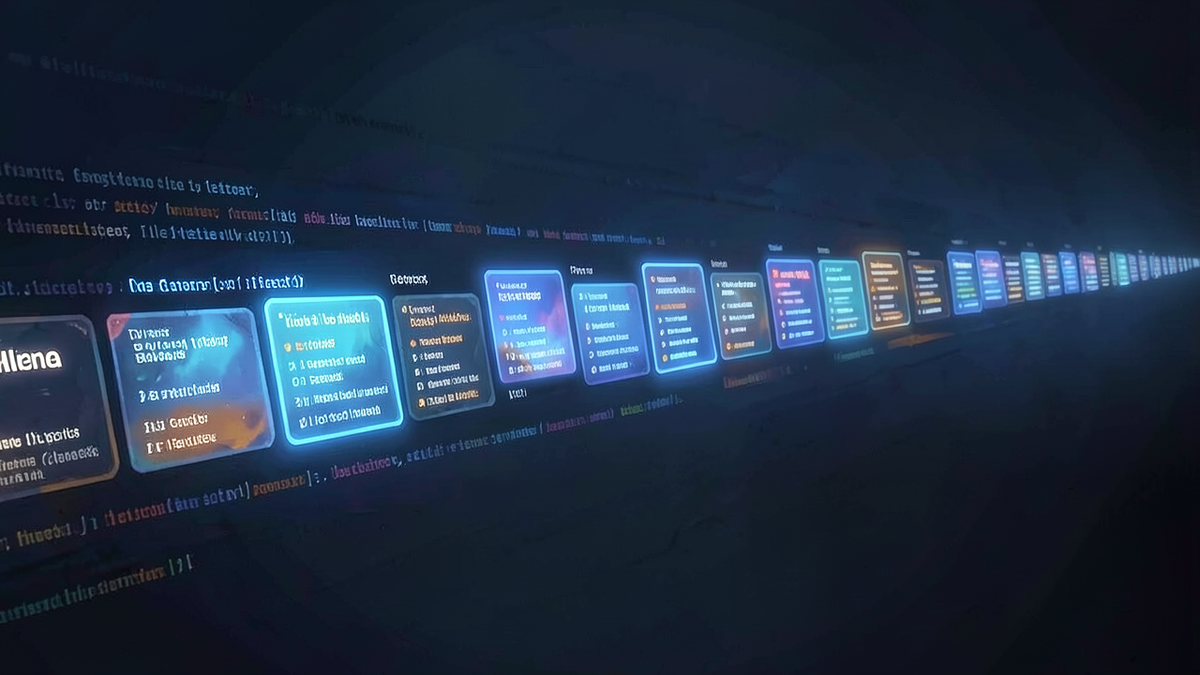
Consider how a database stores events. A row with a timestamp, 2026-06-20T14:03:00Z, doesn't record that an event is happening now. It records that the event stands in earlier-than and later-than relations to other timestamped events. A log file is a B-series made literal: a set of entries ordered by relation, with no privileged "current" entry. The database does not believe any row is more present than another. From the system's point of view, all the timestamped events coexist in a single structure that can be queried, sorted, and replayed at will. This is the block universe rendered in storage.
Event sourcing, an architectural pattern where an application's state is derived by replaying an ordered log of events, takes this further. The canonical reality is the immutable sequence of past events. The "current state" is not a privileged thing that exists on its own; it is computed by folding over the event history. In a strong sense, event-sourced systems are B-theoretic: the present is a derived view, not a fundamental fact, and every past state remains equally real and reconstructable.
Yet the A-theoretic intuition sneaks back in wherever a system has to act. A running program has a genuine "now": the instruction currently executing, the request currently being handled. Schedulers, timeouts, and real-time controllers all treat the present moment as special, because action happens at a moving edge between a settled past and an open future. A self-driving car cannot treat all moments as equally real. It must act now, on the basis of a past it can't change and a future it is trying to influence.
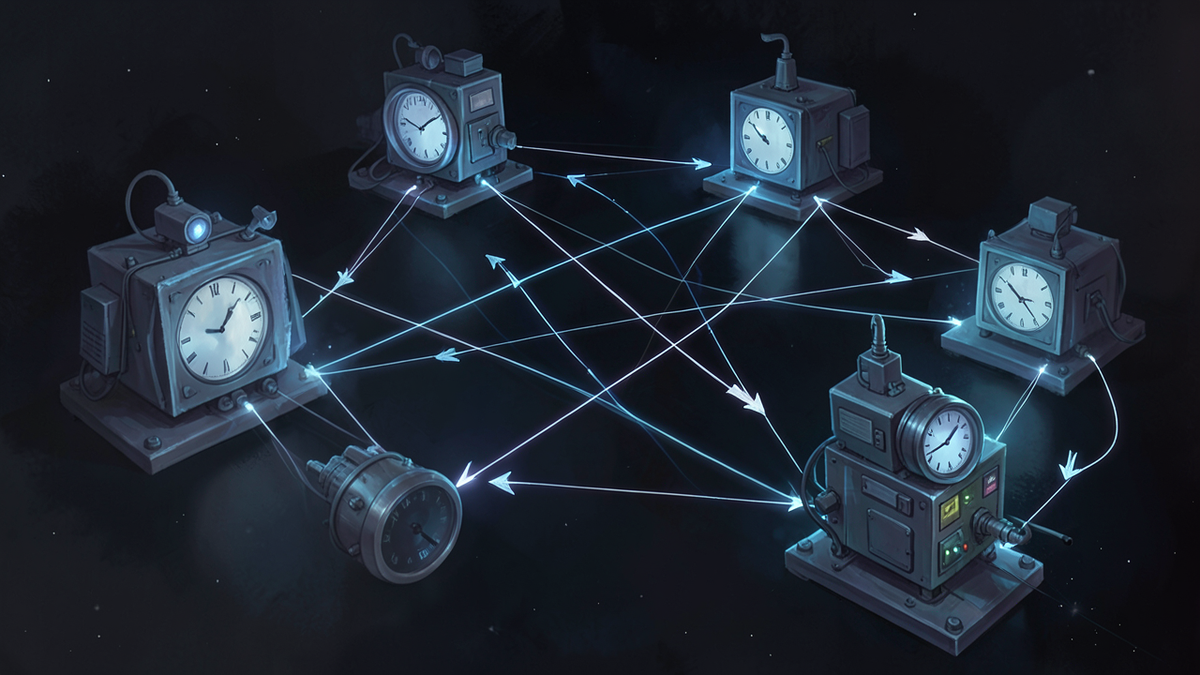
Distributed systems make the tension sharpest. When many machines coordinate, there is no shared, objective "now" they can all agree on, for reasons that rhyme with relativity: signals take time to travel, and clocks drift. This is why distributed systems rely on logical clocks, such as Lamport timestamps, that track only the earlier-than relation of causality rather than any absolute present.[4] Engineers discovered, through hard experience with race conditions and inconsistent replicas, that you cannot safely assume a universal simultaneous "now" across a network. They arrived, for practical reasons, at something like the B-theorist's conclusion: what is real and reliable is the ordering of events, not a global present.
Living in Time
The philosophy of time is not only a technical puzzle. Which theory is true shapes how we might understand our own lives.
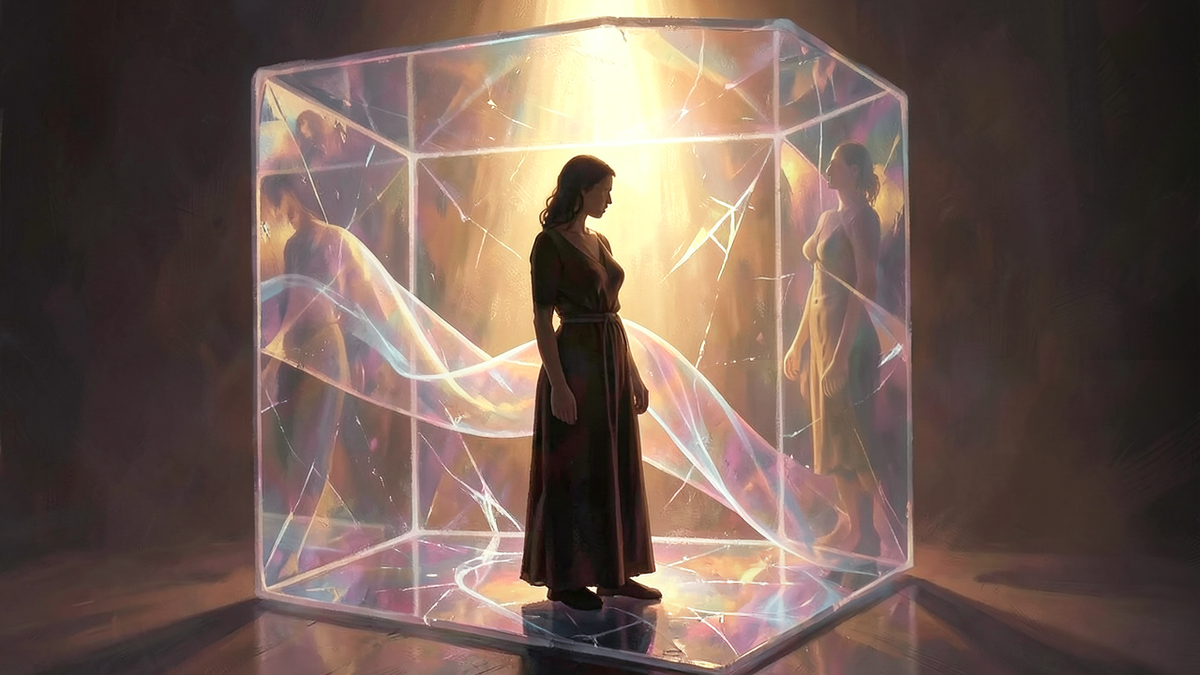
If the B-theory is right and the block universe is real, then every moment of your life exists timelessly. Your childhood is not gone; it is simply located earlier in the structure. A loved one who has died still exists at their place in the four-dimensional whole. Some find this consoling, a kind of permanence that death cannot erase. Others find it chilling, because it seems to imply that the future is as fixed as the past, raising hard questions about freedom and openness.
If the A-theory is right, the flow you feel is the deepest truth about reality. The present is where existence actually happens, the future is genuinely open, and your choices help determine what becomes real. This picture honors the felt urgency of living, though it sits less comfortably with what physics seems to tell us.
The honest state of the debate is that it remains unresolved. Physics leans toward the B-theory, but interpretations of physics are themselves contested, and the raw fact of temporal experience refuses to be explained away. What is striking is how the same tension surfaces wherever time has to be represented, whether in the metaphysics of the cosmos or the timestamp on a database row. We build systems that treat time as an ordered structure of events, then find we still have to act in a present that feels, undeniably, like now. Perhaps that gap between the structure and the experience is not a problem to be solved but the very shape of what it is to be a temporal being.
References
[1] J.M.E. McTaggart, "The Unreality of Time," Mind, Vol. 17, No. 68, 1908, pp. 457-474. https://en.wikisource.org/wiki/The_Unreality_of_Time
[2] For an accessible overview of the relationship between relativity and the philosophy of time, see the Stanford Encyclopedia of Philosophy, "Being and Becoming in Modern Physics." https://plato.stanford.edu/entries/spacetime-bebecome/
[3] Hermann Weyl, Philosophy of Mathematics and Natural Science, Princeton University Press, 1949. https://press.princeton.edu/books/paperback/9780691141206/philosophy-of-mathematics-and-natural-science
[4] Leslie Lamport, "Time, Clocks, and the Ordering of Events in a Distributed System," Communications of the ACM, Vol. 21, No. 7, 1978, pp. 558-565. https://dl.acm.org/doi/10.1145/359545.359563