The Minotaur Learns: When AI Creates New Labyrinths
In February 2025, Andrej Karpathy coined the term "vibe coding" to describe a new way of building software: describe what you want in natural language, let an AI generate the code, and ship it without fully reading what was produced. Within months, the practice had spread from side projects to production systems. A December 2025 analysis by CodeRabbit of 470 open-source GitHub pull requests found that AI-authored code produced roughly 1.7 times more issues than human-written code, with security vulnerabilities up to 2.74 times more common.[1]
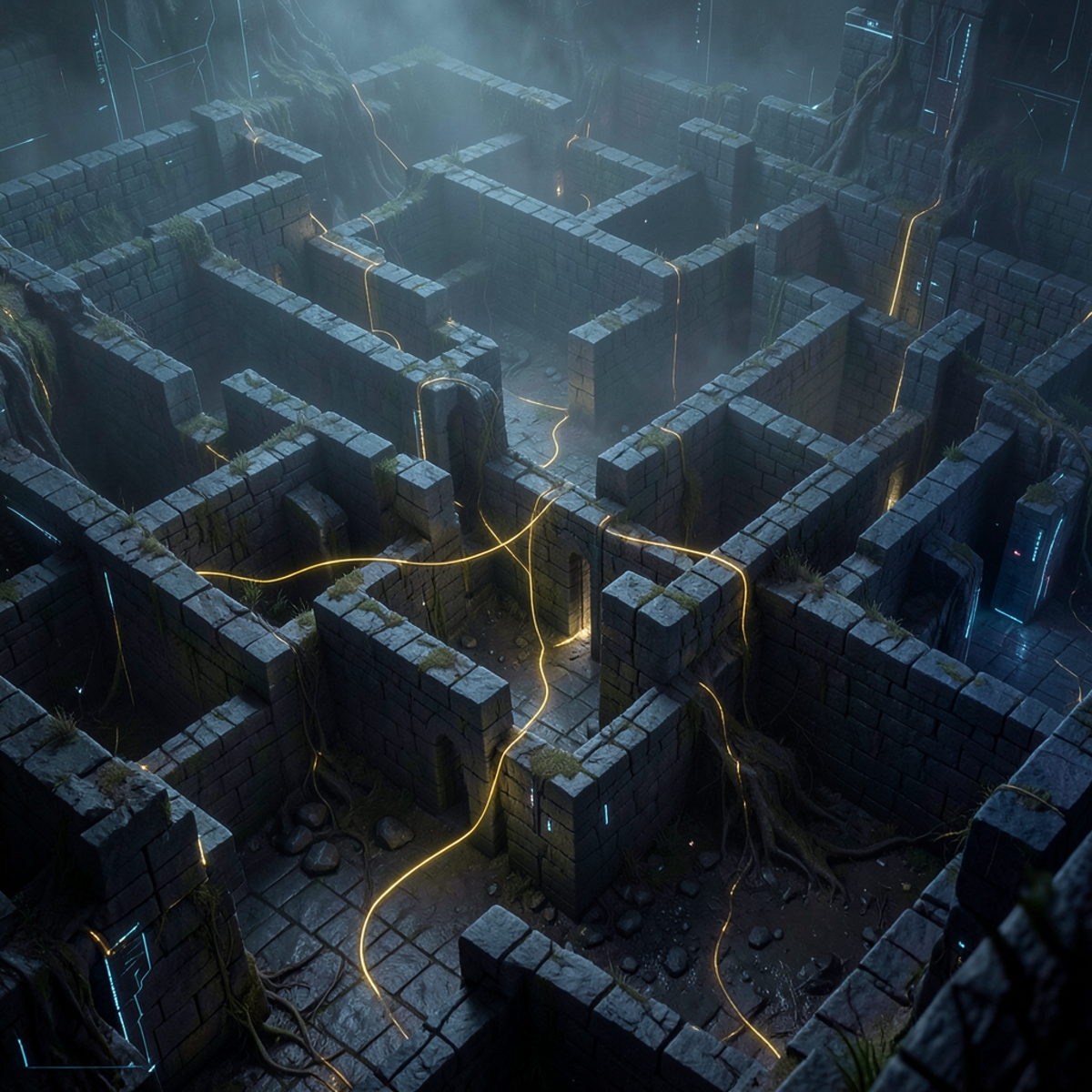
The finding illustrates a paradox that runs through every application of AI to complex systems. AI is Ariadne's thread, the tool that helps us navigate labyrinths too intricate for unaided human comprehension. But AI is also Daedalus, the master builder who constructs new labyrinths faster than anyone can map them. The same technology that traces paths through dependency graphs, correlates signals during outages, and maps cloud architectures is simultaneously generating code nobody fully reviews, producing models nobody fully understands, and enabling systems nobody fully controls.
This is the labyrinth that builds itself.
The Model as Maze
In Greek mythology, the Labyrinth of Crete was complex but static. Once Daedalus finished building it, the corridors didn't move. Modern AI models are labyrinths of a different kind: vast, dynamic, and opaque even to their creators.
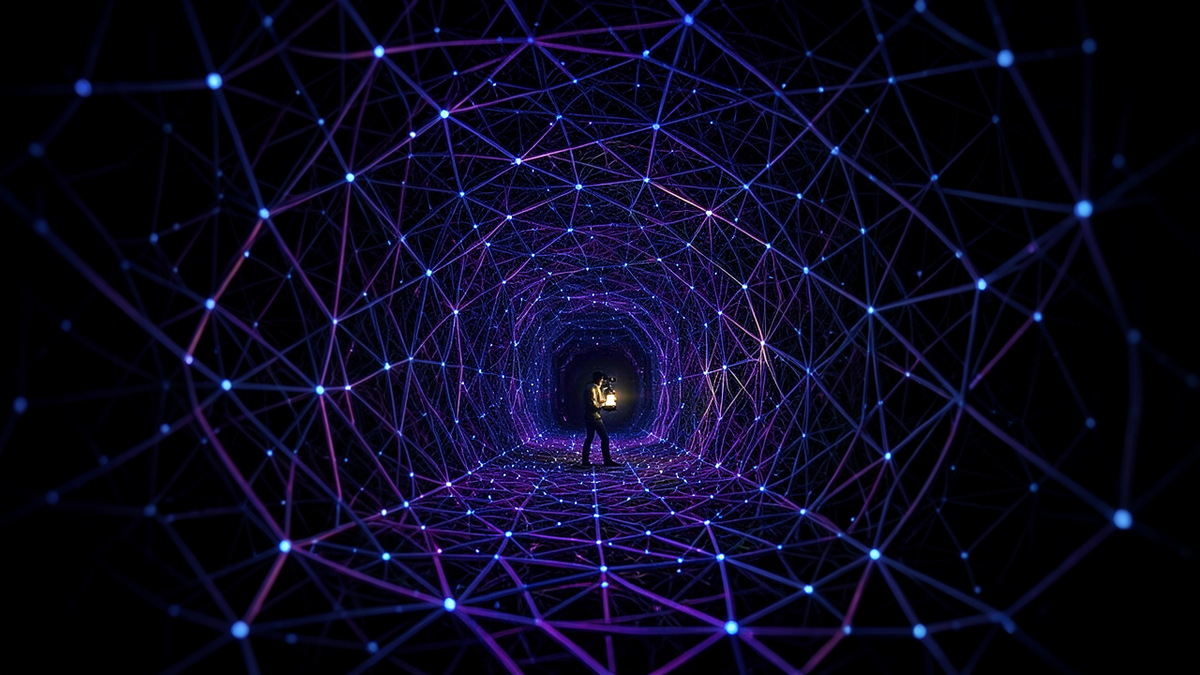
A large language model contains billions of parameters, each adjusted during training through processes that no human directs at the individual level. The result is a system that produces remarkably useful outputs while resisting explanation. Ask a model why it generated a particular response, and the honest answer is that nobody knows, not the engineers who trained it, not the researchers who designed the architecture, not the users who prompted it.
Mechanistic interpretability, a field that MIT Technology Review named one of its 10 Breakthrough Technologies of 2026, aims to change this.[2] In 2024, researchers at Anthropic announced they had identified how millions of concepts are represented inside their language model Claude, mapping features that corresponded to recognizable ideas like specific people, places, and abstract concepts.[3] By 2025, they had begun tracing whole sequences of features, following the path a model takes from prompt to response. Teams at other major AI labs used similar techniques to investigate unexpected behaviors, including instances where models appeared to engage in deception.
The work is promising, but the gap between current interpretability and full understanding remains enormous. The researchers themselves describe the challenge in terms that echo the labyrinth: they've built a microscope that reveals individual corridors, but the full maze, with its billions of interconnected pathways, remains beyond comprehensive mapping. The Minotaur in this labyrinth is the unexpected behavior hiding in the interactions between features that no one has traced end to end.
Code Without Comprehension
The interpretability problem extends beyond the models themselves to the code they generate. AI coding assistants can produce functional software at remarkable speed. The question is whether speed of generation has outpaced the capacity for review.
The Veracode 2026 State of Software Security report documented what it called a growing "remediation gap," where the velocity of AI-driven development significantly outpaces the ability of security teams to identify and fix vulnerabilities.[4] Researchers tracking CVE disclosures found that at least 35 new common vulnerabilities and exposures entries disclosed in March 2026 were the direct result of AI-generated code, up from six in January and fifteen in February of the same year.[5]
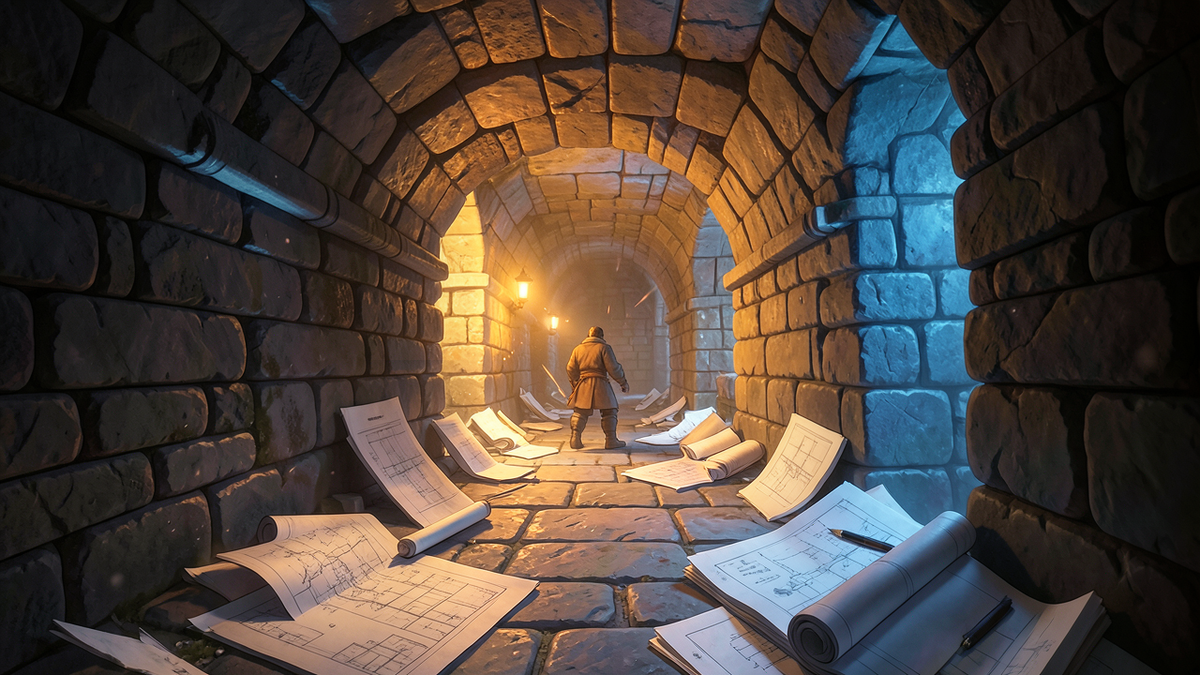
This is corridor construction at industrial scale. Each function generated, each dependency pulled in, each configuration file produced adds paths to the labyrinth. When the developer who accepted the code doesn't fully understand the design decisions embedded in it, the labyrinth grows without a map. The code works, passes tests, ships to production, and becomes part of the system's complexity, a corridor that future engineers must navigate without knowing why it turns where it does.
The pattern is Daedalian in the precise mythological sense: the builder creates something they can't fully navigate. Daedalus built the labyrinth and then couldn't escape it. Developers who generate code faster than they can comprehend it are building labyrinths they can only traverse with the continued assistance of the AI that built them. If the AI changes, or hallucinates, or becomes unavailable, the map disappears.
The Minotaur in the Prompt
AI-powered applications introduce a category of vulnerability that has no precedent in traditional software: prompt injection. In 2025, OWASP ranked prompt injection as the number one vulnerability in its Top 10 for LLM Applications for the second consecutive year.[6]
The structural problem is that language models process system instructions, user input, and retrieved context as a single stream of tokens. There is no hard boundary between "this is what you should do" and "this is what the user said." An attacker who embeds instructions in a document, an email, or a hidden field can redirect the model's behavior. As Cisco's security team observed, prompt injection shares a fundamental design flaw with SQL injection: the mixing of control instructions and user data in a single channel. The critical difference is that SQL injection was eventually solved at the architectural level through parameterized queries. No equivalent architectural fix exists for prompt injection, because the model's ability to interpret natural language flexibly is the product itself.[7]
This is a Minotaur that lives in the architecture of the labyrinth, not in any single corridor. You can't wall it off without walling off the functionality. Every AI-powered application that processes external input contains corridors where adversarial instructions can hide, and the complexity of the model makes it difficult to predict which inputs will trigger which behaviors. The labyrinth doesn't just contain the Minotaur. The labyrinth is the Minotaur.
The Labyrinth That Folds In on Itself
Perhaps the most unsettling form of AI-created complexity is model collapse: what happens when AI systems are trained on data generated by other AI systems.
A 2024 study published in Nature demonstrated that when models are trained recursively on their own outputs, they undergo a degenerative process in which the tails of the original data distribution disappear and the model's outputs converge toward a narrow, impoverished version of reality.[8] The researchers showed this process is, under certain conditions, mathematically inevitable. Early model collapse manifests as a loss of diversity and nuance. Late model collapse produces outputs that bear little resemblance to the original training distribution.
This is a labyrinth that folds in on itself. Each generation of AI-trained-on-AI adds corridors that look like corridors but lead nowhere new. The maze appears to grow, but it's actually shrinking, losing the variety and richness that made the original data valuable. The Minotaur here is subtle: the system appears to function normally while quietly losing its connection to the reality it's supposed to represent.
The practical implications are significant. As AI-generated content proliferates across the internet, the training data for future models will inevitably include synthetic text, images, and code produced by earlier models. Without careful curation to preserve access to human-generated data, the labyrinth of AI capability could gradually collapse inward, each generation a slightly degraded copy of the last.
Icarus and the Discipline of Restraint

In the myth, Daedalus and Icarus escaped the labyrinth on wings of wax and feathers. Daedalus warned his son not to fly too close to the sun. Icarus, exhilarated by the power of flight, ignored the warning and fell.
The parallel to AI-assisted development is direct. AI tools that help manage complexity can also enable the creation of more complexity than we can ultimately control. If the thread makes the labyrinth survivable, the labyrinth grows. If AI-generated code ships faster than it can be reviewed, the codebase becomes a maze that only AI can navigate. If AI-powered systems interact with other AI-powered systems in ways nobody designed, the emergent complexity exceeds what any participant intended.
The discipline required is Daedalian, not Icarian: use the tool to escape the labyrinth, not to build a bigger one. This means treating AI-generated code with the same scrutiny as human-written code, not less. It means investing in interpretability not as a research curiosity but as a practical necessity. It means recognizing that the ability to build complex systems quickly is not the same as the wisdom to know which systems should be built.
The labyrinth that builds itself is the defining challenge of AI in 2026. The thread and the blueprint come from the same hand. The question is whether we use AI to simplify the systems we inhabit or merely to survive in ever-more-complex ones. Daedalus escaped. Icarus didn't. The difference was discipline.
References
[1] Jodie Cook, "Vibe Coding Has A Massive Security Problem," Forbes, March 20, 2026. https://www.forbes.com/sites/jodiecook/2026/03/20/vibe-coding-has-a-massive-security-problem/ The article cites a December 2025 CodeRabbit analysis of 470 open-source GitHub pull requests.
[2] "Mechanistic interpretability: 10 Breakthrough Technologies 2026," MIT Technology Review, January 12, 2026. https://www.technologyreview.com/2026/01/12/1130003/mechanistic-interpretability-ai-research-models-2026-breakthrough-technologies/
[3] Anthropic, "Mapping the Mind of a Large Language Model," May 2024. https://www.anthropic.com/research/mapping-mind-language-model
[4] "Security Debt Crisis Intensifies, AI Is Double-Edge Sword," I-Programmer, reporting on the 2026 Veracode State of Software Security report. https://www.i-programmer.info/news/149-security/18833-security-debt-crisis-intensifies-ai-is-double-edge-sword.html
[5] "Researchers Sound the Alarm on Vulnerabilities in AI-Generated Code," Infosecurity Magazine, 2026. https://www.infosecurity-magazine.com/news/ai-generated-code-vulnerabilities/
[6] OWASP Top 10 for LLM Applications, 2025 update. Prompt injection ranked LLM01:2025 for the second consecutive year. See also Cisco, "Prompt injection is the new SQL injection, and guardrails aren't enough," 2025. https://blogs.cisco.com/ai/prompt-injection-is-the-new-sql-injection-and-guardrails-arent-enough
[7] Cisco Security Blog, "Prompt injection is the new SQL injection, and guardrails aren't enough," 2025. https://blogs.cisco.com/ai/prompt-injection-is-the-new-sql-injection-and-guardrails-arent-enough
[8] Ilia Shumailov et al., "AI models collapse when trained on recursively generated data," Nature, Vol. 631, July 2024, pp. 755–759. https://www.nature.com/articles/s41586-024-07566-y