The Unreasonable Effectiveness of Randomness in AI
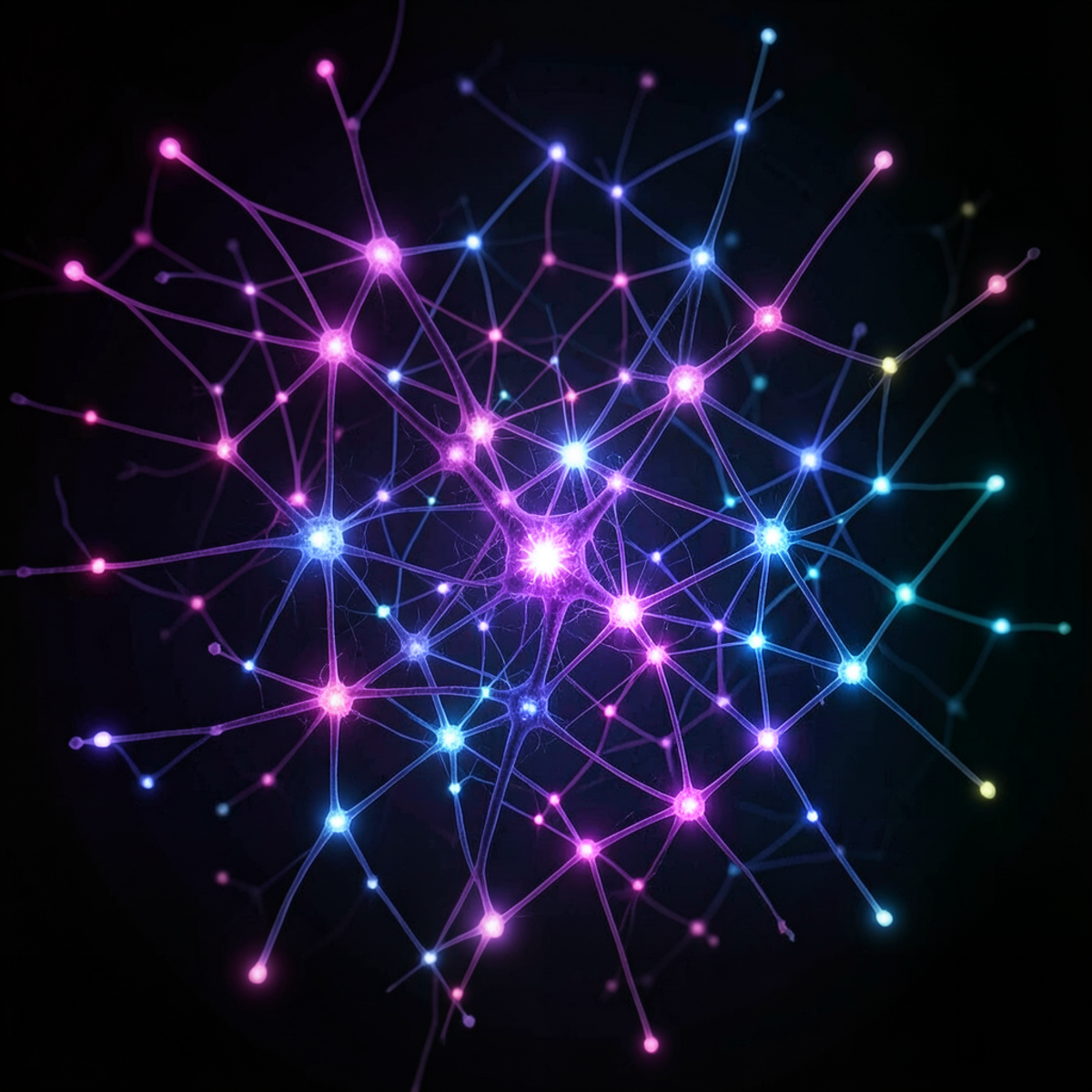
A neural network begins its life in chaos. Before any training occurs, the weights that connect its neurons are set to random values, typically drawn from a carefully calibrated distribution. The network, at this point, knows nothing. It produces random outputs for any input. It is, in a meaningful sense, a random number generator with a lot of parameters.
And yet this randomness is essential. If you initialized every weight to the same value, the network would be unable to learn. Every neuron in a given layer would compute the same function, receive the same gradient, and update in the same way. The symmetry would never break. The network would be stuck, unable to differentiate its neurons into the specialized detectors that make learning possible. Random initialization is what gives each neuron a different starting point, a different perspective on the data, a different role to grow into.[1]
This is the first of many places where randomness turns out to be not just useful but necessary in machine learning. Over decades of empirical and theoretical work, researchers have found that noise often functions as a feature rather than a bug, and that injecting randomness at multiple stages of the learning process can produce models that are more robust, more general, and more capable than their deterministic counterparts.
Stochastic Gradient Descent: Learning from Noise
The most fundamental training algorithm in deep learning is gradient descent: measure how wrong the model is on the training data, compute the direction that would reduce the error, and take a small step in that direction. Repeat until the error is acceptably low.
In its pure form, gradient descent computes the error across the entire training dataset before taking each step. This is called batch gradient descent, and it's deterministic: given the same data and the same starting point, it will always follow the same path. It's also, for large datasets, impractically slow. Computing the gradient over millions of training examples for every single update is computationally expensive.
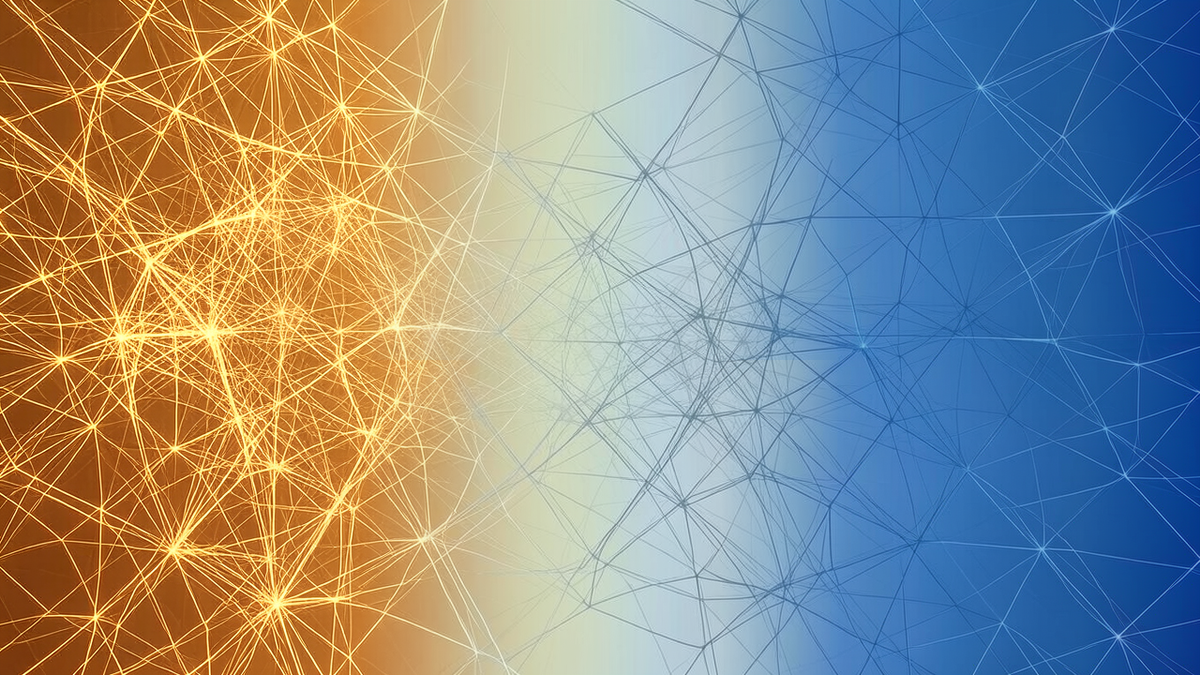
Stochastic gradient descent (SGD) solves this by introducing randomness. Instead of computing the gradient over the entire dataset, SGD computes it over a small, randomly selected subset, called a mini-batch. The gradient computed from a mini-batch is a noisy estimate of the true gradient: it points roughly in the right direction, but with random variation from batch to batch.[2]
This noise might seem like a disadvantage, but research has suggested that it's often beneficial. The noisy gradients can help the optimizer escape local minima, shallow valleys in the loss landscape where a deterministic optimizer might get stuck. The random perturbations push the optimization trajectory around, exploring more of the landscape and tending to settle in broader, flatter minima that generalize better to new data. According to theoretical analyses, the noise in SGD acts as an implicit form of regularization, biasing the optimizer toward solutions that are more robust.[3]
The practical result is counterintuitive: in many cases, training on random subsets of the data, with noisy gradient estimates, produces better models than training on the full dataset with exact gradients. Less information per step, but often better outcomes overall.
Dropout: Randomly Breaking the Network
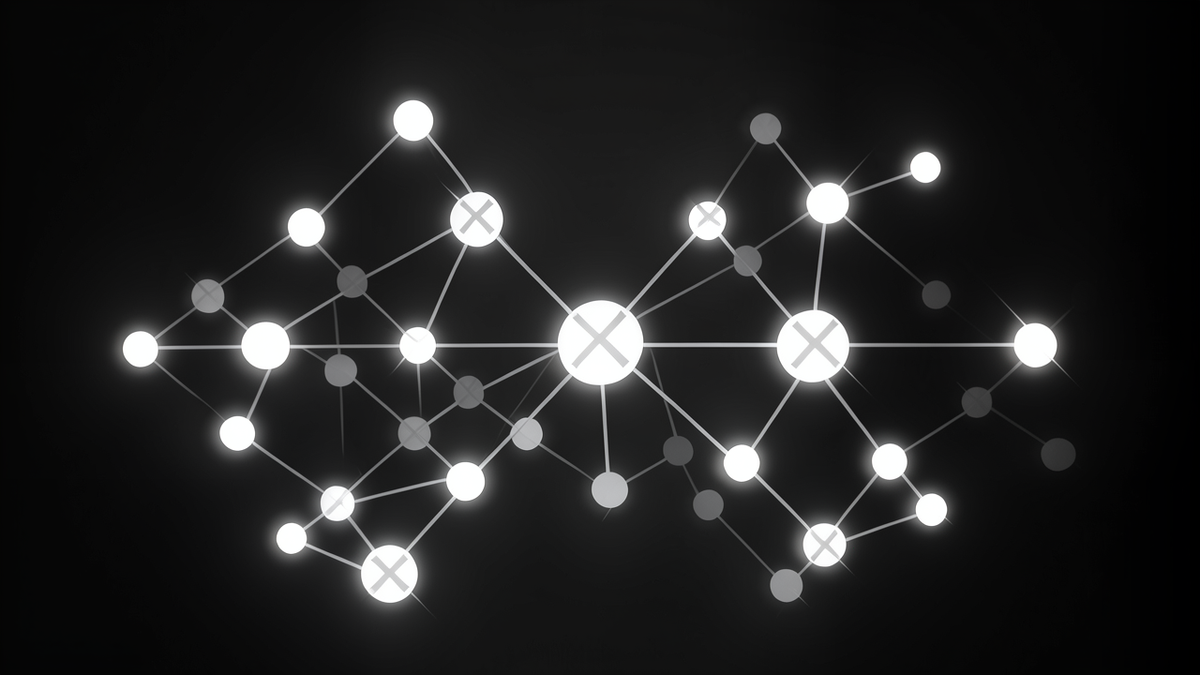
In 2014, Geoffrey Hinton and colleagues published a paper describing a technique called dropout that has since become one of the most commonly cited regularization methods in deep learning. The idea is startlingly simple: during each training step, randomly set a fraction of the neurons in the network to zero. Typically, each neuron has a 50% chance of being "dropped out" on any given step.[4]
The effect is that the network can never rely on any single neuron or any specific combination of neurons. Every neuron must learn to be useful in many different contexts, because it can't predict which of its neighbors will be present on any given training step. This prevents co-adaptation, where groups of neurons become overly specialized and dependent on each other, a pattern that leads to overfitting.
Hinton and colleagues described the intuition behind dropout by analogy to biological evolution. Sexual reproduction, they noted, means that genes can't rely on the presence of specific other genes in the same organism. Each gene must be individually useful across many different genetic backgrounds. Dropout, they argued, creates a similar pressure: each neuron must be individually useful across many different network configurations.[4]
From a practical standpoint, dropout can be understood as training an exponentially large ensemble of sub-networks simultaneously. Each training step uses a different random subset of neurons, which is equivalent to a different sub-network. At inference time, all neurons are active, but their outputs are scaled to account for the fact that more neurons are present than during any single training step. The result is a kind of averaged prediction across all possible sub-networks, which tends to be more robust than any single network's prediction.
The philosophical implication is striking: deliberately damaging the network during training makes it stronger. The randomness forces redundancy, generality, and robustness. A network trained with dropout has learned to function despite missing parts, which means it's less likely to fail when confronted with inputs that differ from its training data.
Data Augmentation: Random Transformations
Another way randomness enters training is through data augmentation. Instead of training on the raw dataset, you apply random transformations to each example: random crops, rotations, flips, color shifts, noise injection. The model sees a slightly different version of each example every time it encounters it.
This serves two purposes. First, it effectively increases the size of the training dataset without collecting new data. Second, it teaches the model invariances: a cat rotated ten degrees is still a cat, a sentence with a synonym substituted still means the same thing. The random transformations encode prior knowledge about what variations are irrelevant, and the model learns to ignore them.
More aggressive augmentation techniques have pushed this further. Techniques like Cutout, which randomly masks rectangular regions of images, and Mixup, which creates synthetic training examples by blending two images and their labels, have shown promising results. SpecAugment, used in speech recognition, randomly masks blocks of frequency channels or time steps in spectrograms. In each case, the randomness creates a harder training problem that, according to the researchers who developed these methods, produces a more capable model.[5]
Temperature and Sampling in Language Models
Randomness plays a different but equally important role in how language models generate text. When a model like GPT produces the next word in a sequence, it doesn't simply choose the most probable word. Instead, it produces a probability distribution over all possible next words, and the next word is sampled from that distribution.
The temperature parameter controls how random this sampling is. At temperature zero, the model always picks the most probable word, producing deterministic but often repetitive and bland output. At high temperature, the distribution flattens, giving less probable words a better chance, producing more creative but potentially incoherent output. Many applications use a moderate temperature, often between 0.7 and 1.0, to balance coherence with variety.[6]
Techniques like top-k sampling and nucleus (top-p) sampling add further control. Top-k sampling restricts the choice to the k most probable words. Nucleus sampling restricts it to the smallest set of words whose cumulative probability exceeds a threshold p. Both techniques use randomness within a constrained space, allowing for variety while preventing the model from choosing wildly improbable words.
The result is that the "creativity" of a language model is, in a precise sense, controlled randomness. The model's knowledge determines the probability distribution. The randomness determines which path through that distribution is taken. Without the randomness, every prompt would produce the same output. The model would be a lookup table, not a generator.
The Lottery Ticket Hypothesis
One of the more surprising recent findings about randomness in neural networks is the lottery ticket hypothesis, proposed by Jonathan Frankle and Michael Carbin in 2019. According to their research, a randomly initialized neural network contains sparse sub-networks, which they called "winning tickets," that can be trained in isolation to match the performance of the full network. The key finding was that these winning tickets depend on their initial random weights: reinitializing them with different random values and training them with the same structure typically doesn't work.[7]
If this hypothesis holds broadly, it suggests that the random initialization of a neural network isn't just a starting point to be optimized away. It's a kind of lottery: the random weights determine which sub-networks have the potential to learn effectively. Training is the process of finding and reinforcing those winning tickets while pruning the rest.
This reframes what neural network training actually does. It's not building a solution from scratch. It's searching through the random structure of the initial network for patterns that happen to be useful, then amplifying them. The randomness isn't just a convenient way to break symmetry. It's the raw material from which learning is carved.
Noise as a Feature
Across all these applications, a pattern emerges: randomness in machine learning isn't a necessary evil or a computational shortcut. It's a design principle.
Random initialization breaks symmetry and enables differentiation. Stochastic gradient descent escapes local minima and finds more generalizable solutions. Dropout prevents overfitting by forcing redundancy. Data augmentation teaches invariance by presenting random variations. Temperature controls the creativity-coherence trade-off in generation. Random initialization may even determine which sub-networks can learn.
The common thread is that noise prevents the system from becoming too specialized, too rigid, too dependent on specific patterns in the training data. Randomness keeps the system flexible, exploratory, and robust. It's a form of epistemic humility built into the learning process: the system doesn't commit too strongly to any single interpretation of the data, because the noise keeps pushing it to consider alternatives.
Biological learning may work similarly. Neuroscience research suggests that neurons are noisy, that synaptic transmission is probabilistic, and that neural development involves substantial randomness in how connections form. It's possible that biological intelligence, like artificial intelligence, depends on noise to avoid overfitting to the environment, to maintain flexibility, and to explore solutions that a purely deterministic system would never find.
The ancient atomists introduced the random swerve to explain how novelty and freedom could emerge from a mechanical universe. Machine learning has discovered something similar: randomness is what allows a deterministic system to learn, to generalize, and to create. The swerve isn't a flaw in the machine. It's the engine.
References
[1] Xavier Glorot and Yoshua Bengio, "Understanding the difficulty of training deep feedforward neural networks," Proceedings of the Thirteenth International Conference on Artificial Intelligence and Statistics (AISTATS), 2010. https://proceedings.mlr.press/v9/glorot10a.html
[2] Léon Bottou, "Large-Scale Machine Learning with Stochastic Gradient Descent," Proceedings of COMPSTAT, 2010. https://en.wikipedia.org/wiki/Stochastic_gradient_descent
[3] Stephan Mandt, Matthew D. Hoffman, and David M. Blei, "Stochastic Gradient Descent as Approximate Bayesian Inference," Journal of Machine Learning Research, 18(134), 1–35, 2017. https://jmlr.org/papers/v18/17-214.html
[4] Nitish Srivastava et al., "Dropout: A Simple Way to Prevent Neural Networks from Overfitting," Journal of Machine Learning Research, 15(56), 1929–1958, 2014. https://jmlr.org/papers/v15/srivastava14a.html
[5] Daniel S. Park et al., "SpecAugment: A Simple Data Augmentation Method for Automatic Speech Recognition," Interspeech, 2019. https://en.wikipedia.org/wiki/Data_augmentation
[6] Ari Holtzman et al., "The Curious Case of Neural Text Degeneration," International Conference on Learning Representations (ICLR), 2020. https://arxiv.org/abs/1904.09751
[7] Jonathan Frankle and Michael Carbin, "The Lottery Ticket Hypothesis: Finding Sparse, Trainable Neural Networks," International Conference on Learning Representations (ICLR), 2019. https://arxiv.org/abs/1803.03635