Escaping the Labyrinth: Simplicity as the Ultimate Thread

We started this week in the workshop of Daedalus, watching the greatest craftsman in the ancient world build a structure so intricate that even he could barely escape it. We end it in a world where every engineer, every organization, every industry is both Daedalus and Theseus: building labyrinths and trying to navigate them, often simultaneously.
The Labyrinth of Crete was built to solve a problem. It contained the Minotaur. It worked. But the containment itself became a problem as dangerous as the creature inside it. Fourteen Athenians died every nine years, not because the Minotaur escaped, but because the labyrinth was too complex for anyone to navigate. The solution became the problem. The containment became the trap.
Technology follows the same pattern with remarkable fidelity. We build complex systems to solve real problems, and the complexity itself becomes the dominant challenge: in incidents, in security vulnerabilities, in onboarding time, in the inability to change direction, in the cognitive load that accumulates until nobody holds the full map.
What the Week Revealed
Each post in this series mapped a different face of the labyrinth pattern in modern technology.
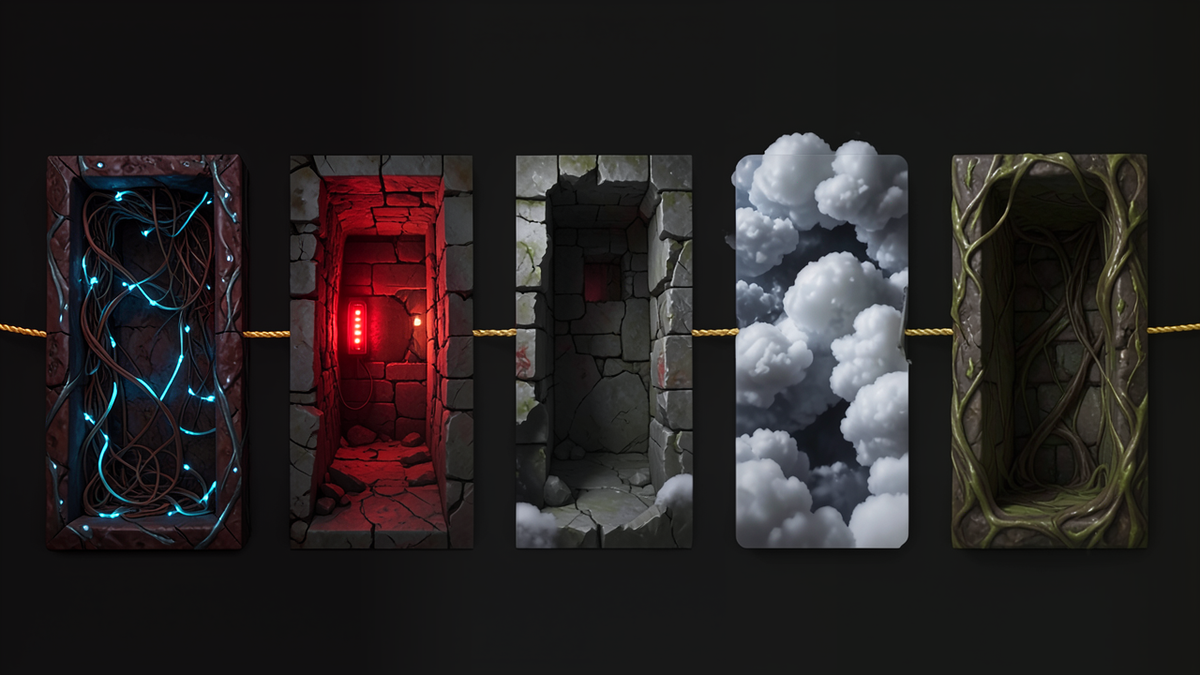
The dependency graph showed that modern applications pull in hundreds or thousands of transitive dependencies, each a corridor in the labyrinth. The Minotaur, a critical vulnerability buried five levels deep in a package nobody knew they had, hides in corridors that no human traces manually. AI-assisted tools are beginning to serve as Ariadne's thread here, distinguishing exploitable vulnerabilities from theoretical ones by tracing actual execution paths through the maze. But the maze grows faster than any thread can map it.
The incident response post showed that every production outage is Theseus entering the labyrinth. The root cause hides behind cascading failures, misleading metrics, and red herrings. Distributed tracing follows requests through dozens of services, and AI-powered observability correlates signals across the system faster than any human can scan dashboards. But the thread is only as good as the instrumentation that creates it, and the engineer who knows when not to trust it.
Technical debt revealed Daedalus's regret: the builder trapped by their own creation. Each shortcut, workaround, and "temporary" solution adds corridors to the labyrinth. When the engineers who built those corridors leave, the map leaves with them. AI can read unfamiliar codebases and suggest refactoring paths, but the deeper value isn't navigating the complexity. It's identifying which walls to tear down.
Cloud architecture showed the labyrinth that nobody designed as a whole. Hundreds of services, thousands of configurations, tens of thousands of IAM policies, all growing organically as teams add infrastructure and compliance requirements add constraints. AI-powered tools can scan live environments and map what's actually deployed, trace attack paths through composite misconfigurations, and identify the blast radius of potential failures. But the goal shouldn't be better navigation of an ever-growing maze. It should be fewer corridors.
The AI complexity post revealed the deepest paradox: AI is both Ariadne's thread and Daedalus's blueprint. The same technology that traces paths through existing labyrinths simultaneously generates code nobody fully reviews, produces models nobody fully understands, and enables architectures nobody fully controls. The labyrinth that builds itself is the defining challenge, and the discipline to use AI for simplification rather than mere survival is the defining virtue.
The Labyrinth Pattern
Across all five cases, the same structural pattern appeared.
Labyrinths grow organically. Nobody designs the whole maze. It accumulates corridor by corridor, decision by decision, each one reasonable in isolation. A new service solves a real problem. A new dependency adds needed functionality. A new configuration meets a compliance requirement. Each corridor is justified. The labyrinth emerges from the aggregate.
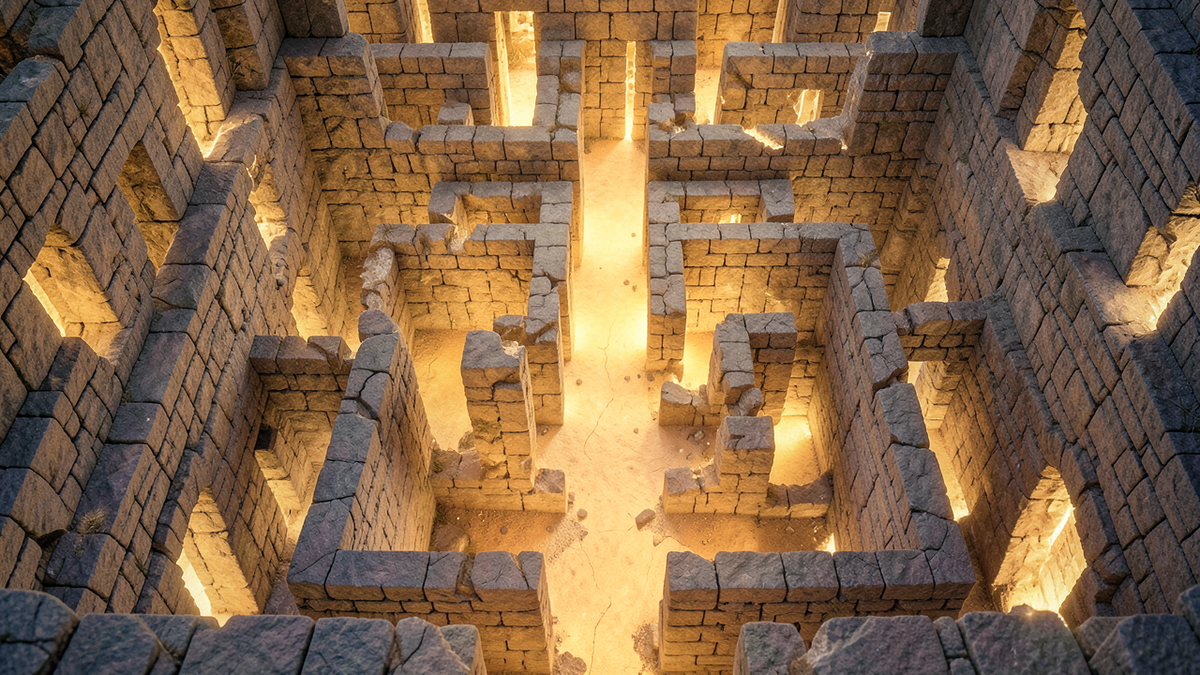
Hidden Minotaurs live in the interactions. The most dangerous problems aren't in any single component. They're in the paths between components that nobody has traced end to end. The Capital One breach exploited a chain of individually unremarkable configurations. Log4Shell hid in a transitive dependency five levels deep. Cascading outages propagate through implicit dependencies that don't appear on any diagram. The Minotaur isn't in the corridor. It's in the path.
Navigation and comprehension are different things. You can trace a path through a labyrinth without understanding its structure. Distributed tracing follows a request through thirty services without explaining why the architecture has thirty services. AI can explain what a codebase does without explaining whether it should be that complex. Navigation is necessary but insufficient. Comprehension is what enables simplification.
Institutional knowledge is a perishable map. The people who built the corridors carry the only maps, and those maps leave when they do. The senior engineer who "just knows" the system is a single point of failure for organizational understanding. AI-assisted comprehension can partially encode that knowledge, but it's a bridge, not a destination. The goal is systems that are comprehensible without requiring either a specific person or a specific AI to explain them.
The complexity ratchet turns one way. Tools that make complexity survivable enable more complexity. If AI-assisted observability makes a hundred-service architecture manageable, the architecture grows to two hundred services. If AI-generated code ships faster than human-written code, the codebase grows faster than anyone can review it. The thread makes the labyrinth survivable, so the labyrinth grows. This ratchet is the central danger.
What the Myth Teaches
The labyrinth myth contains five characters, each mapping to a different aspect of the complexity problem.
Daedalus, the builder, was the greatest craftsman in the ancient world. He built the labyrinth on commission, then couldn't escape it himself. The lesson: expertise in building doesn't guarantee expertise in navigating what you've built. The skills that create complexity are different from the skills that manage it. The best architects can design systems they themselves struggle to debug. Building and operating are different disciplines, and the builder's trap is real.
The Minotaur, the contained problem, was the reason the labyrinth existed. But the labyrinth itself became a problem as dangerous as the creature inside it. Every architectural decision that "contains" a problem, microservices for team autonomy, abstraction layers for complexity management, cloud services for scalability, adds its own complexity. The containment is itself a risk. The solution breeds new problems.
Ariadne's thread, the navigation tool, was separate from the combat tool. Theseus needed a sword for the Minotaur and a thread for the maze. Different problems, different tools. Fixing a bug and understanding the system well enough to find and deploy the fix are separate challenges. AI can help with both, but the navigation problem is often harder than the combat problem. You can kill the Minotaur and still die lost in the maze.
Theseus, the hero, was brave enough to enter the labyrinth, but bravery alone would have killed him. He needed Ariadne's thread. Heroic engineering, the senior developer who "just knows" the system, is brave but unsustainable. Systematic tooling, observability, documentation, AI-assisted comprehension, is the thread that makes courage productive rather than suicidal.

Icarus, the cautionary figure, escaped the labyrinth on wings his father built but flew too high and fell. The tool that liberates can destroy if used without discipline. AI tools that help manage complexity have limits. Using them to justify building ever-more-complex systems is flying too close to the sun. The difference between Daedalus and Icarus wasn't capability. It was restraint.
Two Uses of the Thread
AI can serve as Ariadne's thread in two fundamentally different ways, and the distinction between them is the most important insight this series offers.
The first use is navigation: help me find my way through the labyrinth I have. AI-assisted debugging and root cause analysis. AI-powered code comprehension for unfamiliar codebases. AI-driven security scanning that traces vulnerability paths. AI-enhanced observability that correlates signals across services. This is valuable and necessary. Most organizations have labyrinths they can't demolish overnight. The thread that helps you survive the maze you're in is genuinely useful.
The second use is simplification: help me tear down walls and make the labyrinth smaller. AI-assisted identification of dead code, unused services, and redundant paths. AI-powered refactoring that reduces complexity rather than managing it. AI-driven architecture analysis that identifies which corridors can be collapsed. AI-enhanced migration planning that charts a path from complex to simple. This is more valuable than navigation, because it addresses the root cause rather than the symptom.
The temptation is to stop at navigation. If the thread makes the labyrinth survivable, why simplify? Because survivable isn't the same as sustainable. A labyrinth you can navigate with AI is still a labyrinth. The thread can break. The AI can hallucinate. The model can drift. Dependence on the thread is its own form of fragility. If only the AI understands the system, you've replaced one fragile dependency, the senior engineer who might leave, with another, the model that might change.
Practical Wisdom
The labyrinth tradition, distilled into guidance for people who build and maintain complex systems:
Use AI to map before you build. Before adding a new service, use AI to analyze the existing architecture and identify whether the new corridor is necessary. AI-assisted architecture review as a gate, not just a retrospective tool. The cheapest corridor is the one you don't build.
Prioritize simplification over navigation. When choosing between AI tools that help you manage complexity and AI tools that help you reduce it, prefer the latter. Dead code detection, unused resource identification, redundant service discovery: these are more valuable than tools that merely help you survive the maze as it is.
Treat AI comprehension as a bridge, not a destination. AI that explains a legacy codebase is valuable, but the goal should be making the codebase explainable without AI. Use AI-generated understanding to inform simplification, not to substitute for it.
Measure complexity and track it over time. Use AI to generate complexity metrics: dependency depth, service coupling, configuration sprawl. Track these metrics the way you track performance or cost. Make complexity visible so it can be managed, not just survived. What you measure, you can reduce.
Resist the complexity ratchet. When AI makes it easy to add a new service, ask whether the service is necessary. When AI makes it easy to manage a complex deployment, ask whether the deployment should be simpler. The thread should lead you out of the labyrinth, not deeper in.
Preserve human understanding. AI-assisted navigation is a tool, not a replacement for human comprehension. Engineers who rely entirely on AI to understand systems lose the ability to reason about them independently. The thread supplements the map; it doesn't replace the need to understand the territory.
The Case for Simplicity
John Gall observed in Systemantics that "a complex system that works is invariably found to have evolved from a simple system that worked. A complex system designed from scratch never works and cannot be patched up to make it work."[1] The implication runs both directions: complex systems that work evolved from simple ones, and the path back to reliability often runs through simplification.
Fred Brooks distinguished between essential complexity, which is inherent in the problem being solved, and accidental complexity, which is introduced by the tools and methods used to solve it.[2] Much of what we experience as labyrinthine complexity in modern systems is accidental: it exists because of how we built the solution, not because of what the solution needs to do. AI can help identify accidental complexity, the corridors that exist because of historical decisions rather than current requirements, and chart paths to remove them.
Richard Cook's "How Complex Systems Fail" observed that complex systems contain changing mixtures of failures latent within them, and that catastrophe requires multiple failures, none of which is individually sufficient to cause the disaster.[3] This is the Minotaur hiding in the interactions between corridors. Simplification reduces the number of possible interaction paths, which reduces the number of places where latent failures can combine into catastrophe.
Rich Hickey's distinction between "simple" and "easy" is perhaps the most practically useful framework for engineers.[4] Simple means not interleaved, not braided together. Easy means near at hand, familiar. A tool can be easy without being simple, and simple without being easy. AI coding assistants make building complex systems easy. They don't make those systems simple. The discipline is to pursue simplicity even when complexity is easy.
Escaping the Labyrinth
The deepest lesson of the labyrinth myth isn't about navigation. It's about the cost of complexity itself.
The labyrinth was built to contain a problem. It succeeded. But it also killed fourteen Athenians every nine years, trapped its own builder, and required a hero with divine assistance to resolve. The containment worked, but the cost of the containment exceeded the cost of the original problem.
Theseus didn't improve the labyrinth. He killed the Minotaur and left. Daedalus didn't optimize the labyrinth. He flew over it. The myth doesn't celebrate navigation. It celebrates escape.
The best use of AI in complex systems isn't to make complexity tolerable. It's to make complexity unnecessary. Every wall torn down, every service consolidated, every dependency removed, every configuration simplified is a corridor eliminated from the maze. The goal isn't a better thread. It's fewer corridors.
Simplicity isn't the absence of capability. It's the presence of clarity. A system that does fewer things well is more reliable, more secure, more maintainable, and more comprehensible than a system that does many things adequately. In an age of AI-assisted navigation, the discipline to pursue simplicity rather than settle for survivable complexity may be the most important engineering virtue there is.
We are all building labyrinths. The question is whether we're also tearing them down. The thread is in our hands. The walls are ours to demolish. And the best labyrinth, as Theseus understood, is the one you walk out of and never need to enter again.
References
[1] John Gall, Systemantics: How Systems Really Work and How They Fail, Quadrangle, 1975. Later editions published as The Systems Bible. https://www.goodreads.com/book/show/583785.The_Systems_Bible
[2] Frederick P. Brooks Jr., "No Silver Bullet: Essence and Accidents of Software Engineering," IEEE Computer, Vol. 20, No. 4, April 1987, pp. 10-19. https://www.researchgate.net/publication/220477127_No_Silver_Bullet_Essence_and_Accidents_of_Software_Engineering
[3] Richard I. Cook, "How Complex Systems Fail," Cognitive Technologies Laboratory, University of Chicago, 2000. https://www.researchgate.net/publication/228797158_How_complex_systems_fail
[4] Rich Hickey, "Simple Made Easy," presented at Strange Loop Conference, 2011. https://www.infoq.com/presentations/Simple-Made-Easy/